Best Electric Heaters for Home: Pick the Right Type
The best electric heater for home use depends on your room, preferred warmth and available placement. A ceramic tower circulates warm air, infrared provides radiant heat, an oil-filled radiator works without a fan, and a wall heater keeps floor space open.
On this page (8 sections)
- Which best electric heater type fits your room?
- How should you match the best electric heater to room size?
- Which controls make the best electric heater easier to use?
- Which electric heater fits common home situations?
- How much does the best electric heater cost to run?
- How do you set up and care for an electric heater?
- What mistakes should you avoid when choosing an electric heater?
- Which best electric heater should you choose?
The best electric heater for home use is the one that fits the room, your preferred kind of warmth and a safe place to operate. Ceramic towers circulate warm air, infrared models provide radiant heat, and oil-filled radiators release warmth without a fan.
Start with the room's job. A heater for the desk where you work has a different role from one intended to circulate heat through a bedroom or take the chill off a basement.
Which best electric heater type fits your room?
The best electric heater type depends on whether you want moving warm air, direct radiant warmth or fan-free heat. Match the heating method to how you use the room and where the unit can sit.
| Heater type | How it warms | A practical fit |
|---|---|---|
| Ceramic tower or fan | A fan moves air across a heated ceramic element | You want warm air circulated around a room |
| Infrared or radiant | Radiant heat warms people and nearby objects | You spend time in one area and want direct warmth |
| Oil-filled radiator | A sealed oil reservoir and radiator surfaces release warmth | You want heat without a fan |
| Wall-mounted heater | Mounted near a wall, with warmth directed into the room | You want to keep the heater off the floor |
Room size helps narrow the choice, but it doesn't settle it. Drafts, insulation, ceiling height, room layout and how close you'll be to the heater affect how useful the warmth feels.
Think about your routine before comparing controls. If you change settings from bed or a desk, a remote may matter; if you want heat to stop at a set time, look for a timer that fits your schedule.
Is a ceramic tower the best electric heater for circulating warm air?
A ceramic tower can be the best electric heater for a room where you want warm air to move beyond one spot. The fan sends heated air into the room, and oscillation can spread its direction across a wider area.
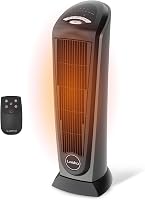
The Lasko 751320 Ceramic Tower has 1500 watts of ceramic heat, wide oscillation, 2 heat settings, a remote and a 7-hour timer. It suits someone who wants a portable tower with simple remote adjustments and timed operation.
Choose this style if you want to adjust heat or oscillation without getting up, or if you move a heater between rooms. Its built-in handle supports moving it, but plan to reposition it only when it is safe and cool to handle.
Skip a fan tower if you want absolutely silent heat or don't want airflow. Fans make some noise, and moving air may feel less direct if your chair or desk is far from the heater.
Set a tower on a flat, stable floor where airflow won't be blocked by furniture or curtains. Keep its cord out of walking paths, and use the manual to confirm clearances and controls before the first run.
For a closer look at the heating method, read how ceramic heaters work. If the room is compact, compare options in our guide to the best space heaters for small rooms.
When is an infrared model the best electric heater for a seating area?
An infrared model can be the best electric heater when you spend most of your time in one part of the room. Radiant warmth suits a reading chair or desk area where you want heat directed toward nearby people and objects.
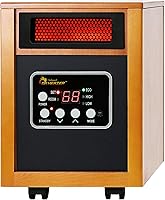
The Dr Infrared DR-968 combines an infrared quartz tube with a PTC element. It has an electronic thermostat, remote control, caster wheels and a 12-hour automatic shut-off timer.
This cabinet-style unit is a fit if you want a freestanding heater that can be moved on its wheels and controlled remotely. It weighs 19 lb, so decide where it will live before moving it across the room.
Skip it if you want a compact heater that you can easily carry from floor to floor, or if you need heat directed at multiple distant areas. Check the manual for clearance around the heater, especially near furniture, bedding and curtains.
Infrared heat doesn't remove the need to plan placement. Keep the area around the heater clear, put it on a stable surface, and don't use it where it could be knocked over or covered.
Our guide to how infrared heaters work explains radiant warmth. For more model options, read best infrared heaters for indoor use.
Is an oil-filled radiator the best electric heater for quiet rooms?
An oil-filled radiator can be the best electric heater for a room where you want warmth without fan airflow. The oil stays sealed inside the unit, and the radiator body releases heat into the room.
The De'Longhi EW7707CM has 1500 watts, 3 heat settings and a ComfortTemp feature. It also has an integrated handle and wheels, so you can move it between rooms without lifting the full weight.
Choose this style for a bedroom, office or other space where fan noise or moving air would distract you. De'Longhi describes its warmth as gentle and fan-free, and its permanently sealed oil reservoir doesn't need refilling.
Skip it if you want heat directed at you quickly from across the room, a lightweight unit to carry, or a wall-mounted solution that frees floor space. The EW7707CM weighs 23.2 lb, so consider the route between rooms and where you'll store it.
Allow room around the radiator and follow the operating and clearance directions. Keep it away from items that could fall onto it, and let it cool according to its instructions before moving or storing it.
See what a convection heater is for more on heat that circulates through a room. If you're weighing radiator warmth against a fan heater, read oil-filled radiator vs space heater.
Should a wall-mounted model be your best electric heater?
A wall-mounted model can be the best electric heater when floor space is limited or you want a fixed heating spot. It stays in one location, so the wall, installation steps and direction of warmth need to work for the room.
The DREO Smart Wall Heater uses a PTC ceramic element and 120° oscillation. It has a remote, app control, Alexa and Google Home compatibility, and temperature settings from 41 to 95°F.
Choose it if you want to schedule heating hours or adjust settings from the app, and if a suitable wall location is available. It can make sense in a bedroom or office where you want to keep the floor clear.
Skip it if you rent and can't mount a heater, want to carry one between rooms, or don't want to choose a permanent location. Before installation, check the included guide, wall clearances and whether the location directs heat where you need it.
For options and placement considerations, see best wall heaters for indoor use. If mounting won't work in your home, a portable tower or radiator is easier to place.
How should you match the best electric heater to room size?
Match a heater's stated coverage to your room as a starting point, then account for drafts, insulation and ceiling height. Coverage is a guide for comparing models, not a promise that every room will feel equally warm.
A small, closed room with good insulation has a different heat load from a large open room or a basement with cold walls. Measure the space, note high ceilings and exterior doors, and consider whether the heater is meant to warm the whole room or the area around one seat.
The Lasko 751320 is described for medium-sized rooms. The DREO 1500W Thermostat Heater specifies 270 sq ft, while the Dr Infrared DR-968 specifies 576 square feet.
Those figures come from different model descriptions and aren't a controlled comparison. Use them as one part of the decision, alongside the heating method, room layout and placement.
The DREO 1500W Thermostat Heater has a thermostat, 70° oscillation and an ECO mode that adjusts between 1000 and 1500 watts. It also has a 12-hour timer and automatic power-off after 24 hours without interaction.
This DREO tower suits buyers who want a compact floor unit, a thermostat and a quiet operation claim from the brand. Its specified coverage and oscillation may be useful in a room where you want warm air distributed beyond the heater's immediate direction.
Skip it if you specifically want fan-free warmth, a wall-mounted unit or a heater without app or smart features in your routine. The manual also says to plug it directly into a wall outlet and not use an extension cord.
For a closer look at power, read how many amps a space heater uses. If a heater repeatedly trips a breaker, use our guide to why a space heater trips the breaker.
Which controls make the best electric heater easier to use?
The best electric heater controls are the ones that match your schedule and room. A thermostat helps set a target temperature, while a timer can limit how long a heater runs.
| Feature | What it helps you do |
|---|---|
| Thermostat | Set a target temperature instead of choosing only a heat level |
| Timer | Schedule a shutoff or limit operating time |
| Tip-over protection | Shut off a portable heater if it tips, when the model includes this feature |
| Overheat protection | Shut down the heater if it gets too hot, when the model includes this feature |
| Remote or app control | Adjust settings without reaching the heater |
A remote is useful when the heater sits across the room, but it doesn't replace checking the controls on the unit itself. App or voice control can add convenience if you already use those tools, while a simple control panel may be easier if you want fewer steps.
Timer lengths vary. The Lasko has a 7-hour timer, the Dr Infrared DR-968 has a 12-hour automatic shut-off timer, and the DREO 1500W Thermostat Heater has a 12-hour timer plus automatic power-off after 24 hours without interaction.
Compare protection features by model rather than assuming every heater of a type includes the same safeguards. The DREO 1500W Thermostat Heater includes tip-over and overheat protection; the Lasko 751320 has overheat protection and cool-touch housing.
Keep portable heaters on a stable, level surface and away from bedding, curtains and foot traffic. Use the manual's placement rules, don't cover a running heater, and plug it into a wall outlet as instructed.
Learn what tip-over protection does and read are ceramic heaters safe? for more on safe use.
Which electric heater fits common home situations?
The right electric heater depends on where you plan to use it and what you need it to do. Use these room-based decisions to shorten your list before comparing individual models.
- Bedroom or home office: Choose a ceramic tower with a thermostat, remote or timer if you want to adjust settings easily. Consider fan sound if you'll sleep or work nearby.
- One chair or desk: Consider an infrared heater for radiant warmth around a specific seating area.
- Room where fan noise is unwelcome: An oil-filled radiator provides heat without a fan, but it weighs more than a small tower and takes planning to move.
- Room with little spare floor space: A wall-mounted model keeps the heater off the floor if the wall and installation suit your home.
- Basement: Check drafts and insulation before settling on a heater. See our guide to heating a basement with a space heater.
A portable heater is usually most useful as supplemental heat in the room you're using. If the space remains cold despite a suitable heater and clear placement, the issue may involve drafts, insulation or the home's main heating system.
How much does the best electric heater cost to run?
The running cost of the best electric heater depends on wattage, run time and your electricity rate. A 1500-watt heater running at full power for one hour uses 1.5 kilowatt-hours.
To estimate the cost, multiply the heater's kilowatts by the hours it runs, then multiply that result by your utility's cost per kilowatt-hour. A thermostat can cycle a heater on and off, so actual consumption may be lower than continuous full-power operation.
The DREO 1500W Thermostat Heater can run at 1000 or 1500 watts in ECO mode. How much electricity it uses depends on the selected settings, room temperature and how often it needs to run.
Reducing the time a heater runs often matters more than choosing between two models with similar wattage. Heat the room you're in, close doors where practical, and use the thermostat and timer in a way that matches your routine.
Use our 1500-watt heater cost-per-hour guide to estimate cost for your rate and schedule. The same method applies to other wattages when you convert watts to kilowatts.
How do you set up and care for an electric heater?
Set up an electric heater on a stable surface or wall location that follows its manual's clearance instructions. Before turning it on, check the cord, plug, controls and nearby area.
For a portable heater, choose a spot away from bedding, curtains, furniture and walking paths. Don't place it where it can be bumped, covered or reached by a pet or child, and keep its cord out of the way.
For a wall model, use the supplied installation guide and confirm the wall can accommodate the unit and its required clearances. Choose the location before mounting so the heater's direction and controls work for the room.
Keep air inlets and outlets free of dust and obstruction. Unplug the heater and let it cool before cleaning, then follow the manual for the right way to remove dust from vents or surfaces.
The De'Longhi radiator has a permanently sealed oil reservoir that doesn't need refilling. That doesn't mean it needs no care: keep its surfaces and wheels clear, and follow its instructions for storage and movement.
Read how to clean a space heater for a practical cleaning routine. If you're deciding between supplemental heat and a fixed room system, see space heater vs baseboard heater.
What mistakes should you avoid when choosing an electric heater?
The most common buying mistakes are choosing by wattage alone, overlooking placement and expecting a portable heater to warm every room equally. Match the heater to both the room and the way you'll use it.
- Treating coverage as exact: A stated coverage area is a starting point. Drafts, insulation, ceiling height and open doorways can change how much warmth you feel.
- Buying for the whole house: Portable models are intended to add warmth where you need it. They may not replace the home's primary heat source.
- Ignoring sound and airflow: A fan tower moves warm air but makes airflow noise. An oil-filled radiator avoids a fan, while radiant warmth suits a more focused area.
- Choosing a wall heater before checking the wall: A fixed model needs a suitable location and installation. Consider rental rules and clearances before buying.
- Using an extension cord against instructions: Follow the heater manual. DREO specifically says its 1500W Thermostat Heater should plug directly into a wall outlet.
- Assuming safety features make placement irrelevant: Protection features are helpful, but you still need to keep the heater stable, uncovered and clear of nearby items.
- Buying controls you'll never use: If you want a simple switch, app or voice controls may add little value. If you want timed operation from bed, a timer or remote may be worth prioritizing.
If your room is especially large, unusually drafty or has limited outlet capacity, check those constraints before choosing a model. Our guide to space heaters for 1,000 sq ft can help frame a larger-room decision.
Which best electric heater should you choose?
Choose the Lasko 751320 if you want a portable ceramic tower with oscillation, a remote and a 7-hour timer. Choose the DREO 1500W Thermostat Heater if you want a thermostat, specified 270 sq ft coverage, 70° oscillation and ECO mode.
Choose the Dr Infrared DR-968 if you prefer a cabinet-style radiant heater with caster wheels and remote control. Choose the De'Longhi EW7707CM for fan-free warmth in a small to medium space, or the DREO Smart Wall Heater if you have a suitable wall and want app or voice controls.
Before buying, decide where the heater will go, how much of the room needs warmth and which controls you'll use. For another shortlist, start with our best 1500-watt space heaters, then check the electrical and placement guidance for your home.
Frequently asked questions
What type of electric heater is best for a bedroom?
For a bedroom, choose a heater with controls that suit your room and routine. A ceramic tower can circulate warm air and may include a remote or timer, while an oil-filled radiator provides quiet, fan-free heat.
Follow the manual's placement and clearance rules.
Turn the heater off when you leave the room or go to sleep unless its instructions specifically support your planned use.
Are infrared heaters better than ceramic heaters?
Infrared heaters provide radiant heat, while ceramic heaters use a fan to send warm air into the room. A radiant model may suit someone staying in one spot; a ceramic model may suit someone who wants moving air to spread warmth.
Neither type is best for every room.
Consider where you'll sit, how much airflow you want and where the heater can be placed safely.
Can a 1500 watt heater heat a large room?
A 1500 watt heater can add warmth to a room, but the result depends on insulation, ceiling height, outdoor temperature and heat distribution. Check the model's stated coverage as a starting point, then account for drafts and the areas you want to warm.
A portable heater is supplemental heat and may not replace a home's main heating system.
Can I plug an electric heater into an extension cord?
Follow the heater's manual and plug it directly into a wall outlet when instructed. DREO says not to use an extension cord with its 1500W Thermostat Heater.
Avoid overloading outlets or power strips.
Stop using a heater if its plug or cord becomes hot or damaged.
Which electric heater is quietest?
Oil-filled radiators heat without a fan, so they avoid fan noise. DREO specifies 34 dB for its 1500W Thermostat Heater, while the Dr Infrared DR-968 specifies 39 dB.
Those figures apply to those specific models.
If sound matters, compare the noise information for the exact heater you're considering and think about whether fan airflow will bother you.