9 Best Infrared Heaters for Indoor Use (October 2026)
The best indoor infrared heaters include the Dr Infrared DR-968 Heater for portable room heating, the Dr Infrared DR-998 Heater for humidifier comfort, and the Heat Storm WiFi Wall Heater for tight floor plans.
On this page (3 sections)
The Dr Infrared DR-968 is the best infrared heater for most indoor rooms, with a remote, 12-hour timer, thermostat and caster wheels. Choose the Heat Storm WiFi Wall Heater when floor space is tight, the BLACK+DECKER tower for personal warmth, or the Ballu panel if you want floor or wall placement.
Infrared heat warms people and objects directly, so it can feel different from a heater that mainly warms room air. Our guide to how infrared heaters work explains the basics, and the right choice depends on where you sit, available floor or wall space, and the controls you want.
This roundup compares 9 indoor infrared heaters by their features and fit. Coverage claims vary by room conditions, so consider insulation, ceiling height and layout when choosing supplemental heat.
Our picks at a glance
-
1
-
2

-
3

The best infrared heaters for different rooms
The DR-968 is the most flexible portable pick, while the wall heater suits a room where floor space matters. These choices span cabinet, tower, wall and panel styles, with different controls and power settings.
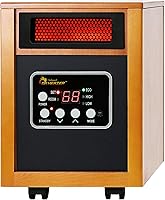
Dr Infrared DR-968 Heater: Best for portable room heating
- 1500 W
- Remote control and 12-hour timer
- 50°F to 85°F thermostat
- Tip-over and overheat protection
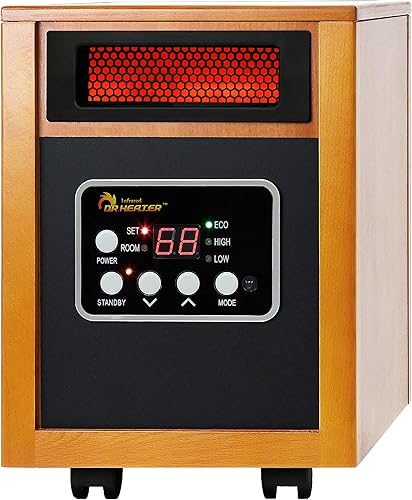
This portable cabinet heater combines an infrared quartz tube with PTC heating. Wheels, a remote and a thermostat make it a flexible pick for rooms where you want adjustable supplemental heat.
Pros
- Remote and 12-hour timer
- Caster wheels for moving between rooms
- Tip-over and overheat protection
Cons
- Heavier than compact options at 19 lb
- Set temperature tops out at 85°F
The Dr Infrared DR-968 Heater combines an infrared quartz tube and PTC heating in a freestanding cabinet. It has caster wheels, a remote, a 12-hour shutoff timer and a thermostat that ranges from 50°F to 85°F.
Tip-over and overheat protection are included. The heater draws 12.5 amps at 1500 W, so consider what else shares the circuit before using it.
The 19 lb cabinet rolls between rooms, though it takes more floor space than a wall unit. Choose it if you want a portable heater with remote control and an adjustable temperature.
Dr Infrared DR-998 Heater: Best for humidifier comfort
- 1500 W dual heating system
- Humidifier and oscillation
- Remote, timer and thermostat
- Tip-over and overheat protection
The DR-998 combines infrared and PTC heat with a cool-mist humidifier and oscillation. It suits buyers who want those features together in a portable cabinet.
Pros
- Humidifier and oscillation included
- Remote, timer and thermostat
- Tip-over and overheat protection
Cons
- Larger footprint than compact portable heaters
- Humidifier adds another feature to maintain
The Dr Infrared DR-998 Heater adds a cool-mist humidifier and oscillation to a 1500 W dual heating system. Its remote, 1–12 hour timer and thermostat from 50°F to 85°F give you several ways to manage comfort.
Tip-over and overheat protection are included, and the cabinet stands on the floor. Pick it if you want a humidifier in the same unit and have room for a cabinet about 16 in deep.
The added features suit a room where a basic portable heater would leave you wanting more control. Skip this model if you don't want the extra humidifier care or would rather keep the heater simple.
Heat Storm WiFi Wall Heater: Best for tight floor plans
- Wall-mounted design
- Wi-Fi controls
- 1500 W
- Remote and tip-over shutoff
This wall-mounted infrared heater frees floor space and adds phone controls. It fits a small room where a freestanding cabinet would get in the way.
Pros
- Wall mount keeps floor space clear
- Wi-Fi temperature control
- Remote and digital thermostat
Cons
- Wall-mounted version does not include feet
- Installation and outlet placement affect setup
The Heat Storm WiFi Wall Heater mounts to the wall, keeping its footprint off the floor. It has Wi-Fi temperature control, a touchscreen thermostat and a remote.
This 1500 W model includes tip-over shutoff. Heat Storm describes a cool-to-the-touch grill and housing, but the manual's placement and clearance directions still matter.
Choose it for a small room where a freestanding heater would take useful space. Skip it if you need a portable unit or cannot mount it in a suitable location.
Our best wall heaters guide covers more mounted options.
Dr Infrared DR-123 Heater: Best for quiet portable use

- 1500 W dual heating
- Four caster wheels
- Remote and 12-hour timer
- Tip-over and overheat protection
The DR-123 pairs infrared and fan-forced heating with four wheels and a remote. Its three modes and programmable timer offer flexible control.
Pros
- Three operating modes
- Four wheels and remote
- Tip-over and overheat protection
Cons
- Remote requires 2 AAA batteries, not included
- Cabinet design needs floor space
The Dr Infrared DR-123 Heater uses infrared and fan-forced heating and rolls on four caster wheels. It includes a remote, 12-hour programmable timer and Eco, High and Low modes.
Its digital thermostat ranges from 30°F to 99°F, and the heater has tip-over and overheat protection. The stated operating noise is under 45 dB, which may appeal if a louder fan would distract you.
Choose it if you want a portable cabinet with several modes and a broad thermostat range. The remote requires 2 AAA batteries, which are not included, so have batteries ready if you plan to use remote control.
Heat Storm Phoenix Heater: Best for dual placement

- 750 W and 1500 W modes
- Removable feet and wall mounting points
- Remote and thermostat
- Tip-over protection
The Phoenix can sit on removable feet or mount on a wall. Two power modes give you a lower setting when full output is not needed.
Pros
- Two power modes
- Floor and wall placement options
- Remote and LED thermostat display
Cons
- Needs a suitable dedicated circuit
- Coverage depends on room conditions
The Heat Storm Phoenix Heater can stand on removable feet or mount on a wall. It offers 750 W and 1500 W modes, a remote and a thermostat with an LED display.
The lower power mode can be useful when full output is more than you need. Heat Storm recommends a dedicated circuit because other high-power devices on the same circuit can trip the breaker.
Consider it if you want one heater that can move from floor placement to a wall setup. Skip it if neither placement works for the room or the circuit requirements are a problem.
For a closer look at this model, see our Heat Storm Phoenix heater review.
Dr Infrared DR-978 Heater: Best for compact cabinets

- 1500 W hybrid heating
- 50°F to 85°F thermostat
- 12-hour timer
- Tip-over and overheat shutoff
This compact freestanding heater combines PTC and infrared heating in a 10 x 9 x 12 in body. It offers a remote, timer and two heat settings.
Pros
- Small cabinet dimensions
- Remote and 12-hour timer
- Tip-over and overheat shutoff
Cons
- Still needs clear floor space
- Low setting is described as both 1000 W and 1200 W
The Dr Infrared DR-978 Heater is a compact freestanding cabinet measuring 10 x 9 x 12 in. It combines PTC and infrared heating, with a remote, 12-hour timer and a thermostat ranging from 50°F to 85°F.
Tip-over and overheat shutoff are included. Its low setting is described as both 1000 W and 1200 W, so don't choose this model if a specific low-power draw is central to your decision.
Choose it when you want a small cabinet with a remote and timer. Our Dr Infrared DR-968 review looks at another portable cabinet in the same brand range.
BLACK+DECKER Infrared Tower: Best for desk-side warmth

- 750 W and 1500 W settings
- Dual quartz tubes and integrated fan
- Adjustable thermostat
- Tip-over and overheat shutoff
This 5 lb quartz tower has two heat settings and an adjustable thermostat. Its personal-heating focus suits a desk or nearby seating area.
Pros
- Lightweight at 5 lb
- Two heat settings
- Tip-over and overheat shutoff
Cons
- Manual controls rather than a remote
- Best suited to personal space, not whole-room heating
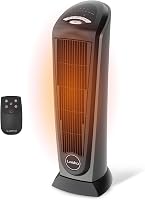
The BLACK+DECKER Infrared Tower uses dual quartz tubes with an integrated fan to spread heat. It has 750 W and 1500 W settings, manual controls and an adjustable thermostat.
At 5 lb, it is the lightest pick here. Tip-over and overheat shutoff are included, but it has no remote and its personal-heating focus makes it a better match for nearby seating than a large shared room.
Choose it for a desk, office or small personal area where a slim tower is easier to place than a cabinet. Skip it if you need whole-room heat or remote control.
For other compact options, see our best space heaters for small rooms.
Ballu Mica Panel Heater: Best for app scheduling

- Mica infrared heating
- Floor stand or wall mount
- App, remote and voice controls
- 24-hour timer and tip-over shutoff
The Ballu panel can stand on its included wheels or mount on a wall. App scheduling and remote controls suit buyers who want several ways to adjust it.
Pros
- Floor and wall setup options
- App and remote controls
- 24-hour timer
Cons
- Panel needs more wall width than compact cabinets
- Voice control depends on a compatible setup
The Ballu Mica Panel Heater can stand on its included wheels or mount on a wall. It uses mica far-infrared heating and includes app, remote, digital panel and voice controls.
A 24-hour timer and tip-over shutoff are included. Ballu gives primary coverage as 250 sq ft and secondary coverage as over 500 sq ft, with actual comfort depending on the room.
Choose it if you want a panel format with floor or wall placement and app scheduling. Skip it if you need a narrow unit, since its 27 in width needs more wall space than compact cabinets.
EdenPURE CopperPLUS Heater: Best for fine temperature steps

- 1500 W high and 1000 W low modes
- 24 temperature settings
- Remote and rolling casters
- Tip-over and dual overheat protection
CopperPLUS offers 24 temperature settings, a remote and rolling casters. Its high and low modes let you choose between 1500 W and 1000 W.
Pros
- 24 temperature settings
- High and low power modes
- Washable filter and rolling casters
Cons
- Cabinet weighs 24 lb
- Room coverage depends on conditions and layout
The EdenPURE CopperPLUS Heater offers 24 temperature settings from 40°F to 90°F, a remote and rolling casters. It has high and low modes rated at 1500 W and 1000 W.
Tip-over shutoff and dual overheat sensors are included, along with a washable filter. EdenPURE describes it as a supplemental heater for rooms up to 1000 sq ft, but insulation and layout affect results.
Choose it if fine temperature steps and a washable filter matter to you. Skip it if you want a lightweight heater: its cabinet weighs 24 lb.
Inspect and clean the filter as the manual directs.
How to choose the best infrared heater
Choose an infrared heater by matching its form, power and controls to the space you use. A portable cabinet works for room-to-room heating, while a wall heater or panel can keep more floor area open.
Which infrared heater fits your room setup?
The best infrared heater for indoor use depends on placement first: choose a cabinet for portability, a tower for personal warmth, or a wall unit when floor space is limited. A panel can offer either floor or wall placement, but check its width and mounting needs.
Treat stated coverage as a guide rather than a promise for every room. Insulation, ceiling height, outdoor temperature and furniture layout all affect how supplemental heat feels.
For a basement, consider room size, insulation and how you use the space before settling on a heater. Our guide to heating a basement with a space heater covers practical setup choices.
Which heater controls will you use?
A remote helps you adjust settings from across the room, while a timer can shut a heater off after a set period. Wi-Fi or app control suits buyers who want phone access or schedules, but those features add little if you'll always use the controls on the unit.
The DR-968 has a 12-hour timer, the Heat Storm wall model has Wi-Fi control, and the Ballu panel has app options. A simple manual thermostat may be enough if you only need occasional heat near a desk.
Check the temperature range as well as the control style. A broad range gives more adjustment choices, while a narrower one can still be enough if you only need a comfortable room setting.
What power setting and circuit should you check?
Many portable infrared heaters in this group draw around 12.5 amps at their highest setting. Check the heater instructions and your circuit, especially if other high-power appliances use the same circuit.
A lower mode may reduce the heater's power draw, as on the Phoenix with its 750 W setting. Don't assume that a second mode makes every circuit suitable.
Read how many amps a space heater uses before choosing where to plug it in.
Avoid running several high-power appliances on the same circuit. If a breaker trips, stop using the heater on that circuit and review the cause before trying another setup.
Our guide to why a space heater trips the breaker covers common reasons and next steps.
Which safety features and placement rules matter?
Look for tip-over and overheat protection, then follow the manual's clearance and placement rules. These features add safeguards, but they don't remove the need to keep a heater away from bedding, curtains and other items that can burn.
Put a portable heater on a stable, level surface with open space around it. Keep the cord out of walkways, and don't cover the heater or place it where furniture can block airflow.
A mounted heater also needs a suitable wall location and installation. If you choose a floor-and-wall model, decide where it will live before assembling its feet or preparing the wall mount.
How do you set up an infrared heater?
Set up the heater on a suitable circuit, in a location with the clearances its manual requires. For a wall model, check the intended mounting location and outlet position before installation; for a portable unit, choose a level surface that keeps the cord safely routed.
Start with a moderate thermostat setting and adjust it after the room has had time to warm. Direct the heater toward the area you occupy, and keep the space between the heater and people clear of objects that could block warmth or airflow.
If you move a heater between rooms, switch it off and let it cool before relocating it. Use its wheels or handles where provided, and avoid pulling it by the power cord.
How should you care for an infrared heater?
Keep air openings clear and clean the heater as its manual directs. Some picks include a washable or lifetime filter, which still needs inspection and cleaning according to the instructions.
Unplug the unit before routine cleaning and let it cool first. Wipe exterior surfaces with a dry or slightly damp cloth if the manual permits, and don't put water into vents or controls.
See our space heater cleaning guide for general care steps.
What common heater mistakes should you avoid?
The most common mistakes are expecting a portable heater to replace whole-home heat, placing it too close to fabrics, and overlooking circuit load. A heater's coverage estimate depends on the room, and comfort can vary from one end of a space to another.
Don't use an extension cord or power strip unless the heater manual specifically allows it. Don't leave a portable heater running unattended or while sleeping unless its manual says that use is permitted.
Avoid buying features you won't use. A humidifier needs care, app controls need a compatible setup, and a wall mount takes planning.
A straightforward portable model may be the better fit if you only need occasional supplemental warmth.
Which infrared heater should you choose?
Choose the Dr Infrared DR-968 if you want a portable cabinet with a remote, timer and caster wheels. Pick the Heat Storm WiFi Wall Heater to preserve floor space, the BLACK+DECKER tower for personal heating, or the Ballu panel for app controls and floor or wall placement.
If you want extra room comfort in one cabinet, choose the DR-998 for its humidifier and oscillation. For lower power mode flexibility, choose the Heat Storm Phoenix.
Skip the panel if its width won't fit, and avoid any model whose setup or features add work you don't need.
For a broader comparison across heater styles, start with the best electric heaters for home. If you're deciding between infrared and another portable style, use our infrared heater vs space heater guide.
Our top 3 picks at a glance
-
1
-
2
-
3
Frequently asked questions
Do infrared heaters warm a whole room?
Some infrared heaters can add supplemental warmth across a room, but results depend on insulation, ceiling height, outdoor temperature and layout. A heater's stated coverage is a starting point, not a guarantee for every home.
For comfort where you sit, place the heater according to its manual and keep clear space around it.
Is an infrared heater better than a ceramic space heater?
Infrared heaters warm people and objects directly, while ceramic heaters generally warm air and move it with a fan. Which feels better depends on the room and whether you want directed warmth or air circulation.
See our infrared heater and space heater comparison for the differences.
Can an infrared heater run on a regular household outlet?
These electric models are designed for indoor use, but check the heater's power requirements and the circuit before use. A 1500 W heater can draw substantial current, especially if other high-power devices share the circuit.
Our guide to how many amps a space heater uses explains what to check.
Are infrared heaters safe to leave on overnight?
Use a portable heater only as its manual allows, and follow its clearance and placement rules. Tip-over and overheat shutoffs add protection, but they don't replace safe use or make a heater suitable for unattended operation.
Keep heaters away from bedding, curtains and other materials that can burn.