9 Best Space Heaters With Remote Control (October 2026)
The best space heaters with remote controls include the Lasko 751320 Ceramic Tower for everyday rooms, the DREO Quiet Remote Heater for quiet bedrooms, and the DREO 16 Inch Remote Heater for rooms under 270 sq ft.
On this page (6 sections)
The Lasko 751320 Ceramic Tower is our top pick among space heaters with remote control because its remote handles heat settings, oscillation and a 7-hour timer. For a quieter bedroom option, consider the DREO Quiet Remote Heater; the DREO 16 Inch Remote Heater suits rooms under 270 sq ft.
A remote is most useful when it controls the settings you reach for often. Compare the heat style, room fit, timer and safety features, then consider where the heater will sit.
Our picks at a glance
-
1
-
2

-
3

- 4
 Best for taller towersCheck it
- 5
 Best for moving between roomsCheck it
- 6
 Check it
DREO 30 Inch Oscillating Heater
Best for wide room coverage - 7
 Best for wall placementCheck it
- 8
 Check it
Amazon Basics Remote Oil Heater
Best for silent heating - 9
 Best for infrared with ECOCheck it
How we chose space heaters with remote control
We compared remote functions, heating style, timer, thermostat and safety features. The score reflects how those features match the needs of someone shopping for convenient room heat.
We also considered quiet operation, broad oscillation, rolling mobility and wall placement. A stated coverage area is a guide, so account for drafts, ceiling height and room layout before choosing.
Compare remote-control space heaters
The best match depends on which controls you want at hand and the kind of heat that suits your room. This table highlights the main differences across the 9 picks.
| Product | Best for | Heat output | Heating style | Controls | Our score |
|---|---|---|---|---|---|
| Lasko 751320 Ceramic Tower | everyday rooms | 1500W | Ceramic forced air | Remote, 2 heat settings, oscillation, 7-hour timer | 9.1 |
| DREO Quiet Remote Heater | quiet bedrooms | 1500W | PTC forced air | Remote, thermostat, 70-degree oscillation | 8.7 |
| DREO 16 Inch Remote Heater | rooms under 270 sq ft | 1500W | PTC forced air and convection | Remote, 3 heat settings, ECO mode | 8.4 |
| Lasko 5586 29 Inch Tower | taller towers | 1500W | Ceramic forced air | Remote, 2 heat settings, oscillation, 8-hour timer | 8.4 |
| Dr Infrared DR-123 Heater | moving between rooms | 5200 BTU | Infrared quartz and forced air | Remote, 3 modes, digital thermostat | 8.0 |
| DREO 30 Inch Oscillating Heater | wide room coverage | 1500W | PTC ceramic forced air | Remote, 5 heat levels, ECO mode, oscillation | 7.9 |
| Heat Storm Phoenix Heater | wall placement | 750W or 1500W | Infrared quartz | Remote and built-in thermostat | 7.9 |
| Amazon Basics Remote Oil Heater | silent heating | 1500W maximum | Radiant oil-filled radiator | Remote, adjustable thermostat, 3 heat settings | 7.4 |
| Amazon Basics Remote Heater | infrared with ECO | 750W or 1500W | Infrared | Remote, adjustable thermostat, ECO-Smart setting | 7.3 |
The best space heaters with remote control
The Lasko 751320 offers a useful mix of remote functions for everyday use, while the other models suit different rooms and preferences. Choose the features that matter most for your space.
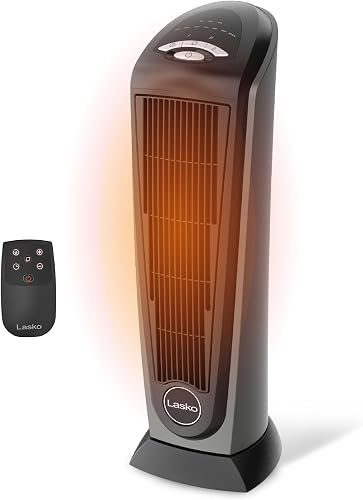
Lasko 751320 Ceramic Tower: Best for everyday rooms
- 1500W ceramic heat
- Widespread oscillation
- 2 heat settings
- 7-hour timer
The remote controls heat settings, oscillation and the timer. A carry handle helps when you move the tower between rooms.
Pros
- Remote controls key settings
- Widespread oscillation
- Overheat protection and cool-touch housing
Cons
- Lasko describes it for medium-sized rooms
- The remote's operating range isn't specified
The Lasko 751320 is a straightforward choice if you want to adjust the heat settings, oscillation and timer without getting up. Its widespread oscillation moves warm air across a broader area than a fixed direction.
The timer sets a run period, and the carry handle helps when you move the heater between rooms. Lasko describes it for medium-sized rooms, so consider drafts, ceiling height and furniture when deciding whether it suits your space.
Two heat settings keep the controls simple. It has a ceramic element, overheat protection and cool-touch housing.
Choose this model if you want a tower shape and a remote that handles the core settings. Its stated room fit is more limited than DREO's recommendation for the 16 Inch Remote Heater.
DREO Quiet Remote Heater: Best for quiet bedrooms
- 1500W PTC heat
- 70-degree oscillation
- 34 dB noise claim
- Thermostat from 41°F to 95°F
DREO says its brushless DC motor and winglet fan design keep noise as low as 34 dB. The remote, thermostat and oscillation let you adjust warmth from across the room.
Pros
- Remote control included
- Child lock and tip-over protection
- Thermostat adjusts in 1°F increments
Cons
- Thermostat range may be wider than some rooms need
- Room coverage depends on the space and conditions
The DREO Quiet Remote Heater suits a bedroom or office where low operating noise matters. DREO says its brushless DC motor and winglet fan design reduce noise to as low as 34 dB.
Its remote, thermostat and 70-degree oscillation let you adjust warmth without walking over to the heater. The thermostat ranges from 41°F to 95°F in 1°F steps.
Safety features include child lock, tip-over protection, overheat protection and a safety plug. DREO gives this heater a coverage area of 200 sq ft, though room layout and insulation can affect how evenly the space warms.
Pick it if quiet operation and thermostat control matter most. The remote's timer controls aren't specified, so check whether the timer function is available from the remote if that's important to you.
DREO 16 Inch Remote Heater: Best for rooms under 270 sq ft
- 1500W PTC heat
- 70-degree oscillation
- ECO mode
- 12-hour timer
DREO recommends this heater for areas under 270 sq ft. Its remote and ECO mode give you options for adjusting heat.
Pros
- Three heat settings plus ECO mode
- Tip-over and overheat protection
- 70-degree oscillation
Cons
- Remote control requires a battery
- Room size recommendation is not a guarantee of comfort
The DREO 16 Inch Remote Heater suits a room under 270 sq ft, the area DREO recommends. Its 70-degree oscillation and airflow design spread warmth beyond the space right next to the unit.
The remote lets you change settings from a chair or bed. Heat options include low, medium and high, plus ECO mode, which adjusts heat to maintain the preferred temperature.
Safety features include tip-over and overheat protection, V-0 rated flame-retardant material and an enhanced safety plug. DREO says it operates at 34 dB.
Choose this model when you want several heat modes and a stated room recommendation. If you need more directional control or a different heating style, compare it with the infrared picks below.
Lasko 5586 29 Inch Tower: Best for taller towers
- 1500W ceramic heat
- Widespread oscillation
- 2 heat settings
- 8-hour timer
This taller tower combines oscillation with an 8-hour timer. Its remote controls heat, oscillation and timer settings.
Pros
- Remote control included
- Overheat protection and cool-touch exterior
- Carry handle for moving it
Cons
- Taller than compact tabletop heaters
- Remote requires 2 AAA batteries, not included
The Lasko 5586 is a taller ceramic tower with a remote for heat, oscillation and timer settings. Its 8-hour timer provides one more hour than the Lasko 751320's timer.
The 29.5-inch height and widespread oscillation suit buyers who prefer a taller tower format. Two heat settings keep operation simple, while the digital display and electronic controls let you adjust the heater at the unit.
Overheat protection and a cool-touch exterior are included. The remote requires 2 AAA batteries, which aren't included.
Pick this model for a taller tower and a longer timer. If you want a shorter unit, the DREO Quiet Remote Heater is 14.65 inches tall.
Dr Infrared DR-123 Heater: Best for moving between rooms
- Infrared quartz and PTC fan heat
- 4 caster wheels
- 12-hour timer
- Thermostat from 30°F to 99°F
Four caster wheels make this cabinet-style heater easier to move across a floor. Its remote and 12-hour timer let you adjust settings from across the room.
Pros
- Dual heating methods
- Tip-over and overheat protection
- Thermostat range from 30°F to 99°F
Cons
- Weighs 18 lb
- Remote requires 2 AAA batteries, not included
The Dr Infrared DR-123 combines infrared quartz and PTC fan-forced heat in a cabinet-style heater. Its four caster wheels make it easier to move across a floor.
Use the remote and programmable 12-hour timer to manage settings from across the room. Its digital thermostat ranges from 30°F to 99°F, and Eco, High and Low modes offer three ways to run it.
The DR-123 weighs 18 lb. It has tip-over and overheat protection, and its remote requires 2 AAA batteries, which aren't included.
Choose it if you want radiant and fan heat with a wheeled base. The cabinet takes more room than a compact tower, so check the floor space where you plan to use it.
DREO 30 Inch Oscillating Heater: Best for wide room coverage
- 1500W ceramic heat
- Customizable oscillation up to 120 degrees
- 5 heat levels and ECO mode
- 1–12-hour timer
Choose 30°, 60°, 90° or 120° oscillation to spread airflow across a wider angle. DREO describes it for rooms up to 300 sq ft.
Pros
- Remote control included
- Multiple oscillation angles
- Child lock and tip-over protection
Cons
- At 29.7 inches tall, it needs more floor height than compact models
- DREO recommends a stable voltage environment
The DREO 30 Inch Oscillating Heater stands out for its adjustable oscillation angle, with 30°, 60°, 90° and 120° options. That range lets you choose a wider sweep when several parts of a room need airflow.
It offers five heat levels, ECO mode and three fan levels, along with a 1–12-hour timer. The remote is included, and the heater has child lock, tip-over protection and overheat protection.
DREO describes it for rooms up to 300 sq ft and says it runs at 25 dB. Treat room size as a starting point and account for insulation, drafts and placement.
Choose this model if you want more oscillation choices than a typical tower offers. Its 29.7-inch height makes it less suited to shelves or cramped corners.
Heat Storm Phoenix Heater: Best for wall placement
- Infrared quartz heat
- 750W and 1500W modes
- Remote thermostat control
- Wall or floor mounting
The Phoenix can sit on its attachable feet or mount on a wall. The remote controls temperature, and two power modes offer a lower setting and full power.
Pros
- Wall and floor placement options
- Two power modes
- Compact cabinet form
Cons
- The manufacturer says it needs a dedicated circuit
- Wall mounting takes planning
The Heat Storm Phoenix can sit on attachable feet or mount on a wall, which gives you placement options when floor space is tight. It uses infrared quartz heat and has 750W and 1500W power modes.
The remote controls temperature, and a built-in thermostat with LED display shows ambient temperature. Heat Storm describes the Phoenix for a small room or office.
Heat Storm says the Phoenix needs a dedicated circuit. Check your room's electrical setup and mounting plan before buying, especially if other high-power devices share the circuit.
Choose the Phoenix when placement options matter more than oscillation. For a room where you want warm air moving around, a ceramic tower may suit you better.
Amazon Basics Remote Oil Heater: Best for silent heating
- Oil-filled radiator
- 7 fins
- 3 heat settings
- Permanently sealed oil
This oil-filled radiator has no fan, so it provides silent heating. Its sealed oil requires no refills or maintenance.
Pros
- Fan-free operation
- Three power settings: 600W, 900W and 1500W
- Tip-over and overheat protection
Cons
- Radiator form takes floor space
- Warms differently from a fan-forced tower
The Amazon Basics Remote Oil Heater suits buyers who prefer fan-free, quiet heating. Its seven oil-filled fins provide heat without a fan, and the sealed oil needs no refills or maintenance.
The remote pairs with an adjustable thermostat and three heat settings: 600W, 900W and 1500W. The radiator retains heat after it's turned off, so it behaves differently from a fan heater that stops blowing warm air when it shuts down.
This heater has tip-over and overheat protection. Allow enough floor space around it and keep it away from items that could block or cover it.
Choose this heater if quiet operation is a priority and you don't need forced airflow. If you want heat to move around the room, compare it with a ceramic tower.
Amazon Basics Remote Heater: Best for infrared with ECO
- Four infrared heating elements
- 750W and 1500W settings
- ECO-Smart setting
- Remote control
Four infrared elements and two power settings give this cabinet heater a different heat style from ceramic fan heaters. It has an adjustable thermostat and an ECO-Smart setting.
Pros
- Remote and LED display
- Two power settings
- Overheat sensor
Cons
- Remote batteries are not included
- Cabinet form uses more floor area than a small tower
The Amazon Basics Remote Heater uses four infrared elements with 750W and 1500W power settings, plus an ECO-Smart setting. Its infrared heat style gives you an alternative to ceramic fan heaters.
The adjustable thermostat covers 65°F to 85°F, and an LED display makes settings easier to read. A remote is included, though its batteries are not.
The heater is described for rooms up to 160 sq ft and has an overheat sensor. Tip-over protection isn't specified, so follow the manual's placement instructions.
Choose it if you want infrared heat with an ECO setting and a display. It may not suit you if you want broad oscillation or tip-over protection.
How to choose a space heater with remote control
Choose by room layout, heat style and the remote functions you will use. Match the heater to the space where you sit, work or sleep, then check its controls and safety features before you settle on a model.
Which remote controls matter most on a space heater?
A thermostat and heat-level control help you adjust warmth without approaching the heater. Oscillation control is useful when you want to redirect airflow, while a timer lets you set a run period.
If you mainly want to turn a heater on or off from your seat, a simpler remote may be enough. Check whether the remote handles each setting you care about, since some adjustments may only be available on the unit.
Which heater type and room fit suit you?
A ceramic tower moves warm air around a bedroom or office. Infrared cabinets suit buyers who prefer radiant heat, while an oil-filled radiator provides fan-free warmth.
Measure the floor area and note where the outlet sits. The Heat Storm Phoenix can mount on a wall, though it still needs a suitable mounting location and electrical setup.
How do timers and thermostats differ?
A timer sets how long the heater runs before it shuts off. A thermostat sets the target temperature and cycles heat to maintain it.
For timed operation, see our guide to space heaters with a timer. Our guide to choosing an electric heater for home explains how ceramic, infrared and oil-filled options differ.
How should you set up a remote-control heater?
Set the heater on a stable, level surface with the clear space around it that the manual requires. Keep it away from curtains, bedding, furniture, walkways and other items that could block it or be knocked against it.
Plug it directly into a wall outlet unless the manual specifically permits another setup. Before settling in, test the remote from your usual seat, learn which buttons change heat and timer settings, and place the remote where it won't get buried or lost.
What common mistakes should you avoid?
Don't assume that a remote controls every function. Confirm the timer, thermostat and oscillation controls you need, and check whether the remote requires batteries.
Don't choose by the largest coverage figure alone. A room with drafts, poor insulation, high ceilings or blocked airflow may feel different from the area a manufacturer recommends, so choose a heater for your actual room and placement.
Don't cover the heater or leave objects close to its air intake or outlet. A timer or safety shutoff is a useful control, but it doesn't replace following the manual and keeping the heater attended as recommended.
How to use a remote-control space heater safely
A remote doesn't replace safe placement, a suitable outlet or the heater's manual. Keep the unit on a stable, level surface and follow the clearances the manufacturer specifies.
Avoid plugging a space heater into an extension cord or power strip unless its manual explicitly allows it. For electrical load context, read how many amps a space heater uses, and stop using a heater if its plug, cord or outlet becomes hot.
Tip-over protection can shut off some heaters if they fall, but it doesn't prevent every accident. Read what tip-over protection does on a space heater to understand the feature and its limits.
How can you care for a heater and remote?
Unplug the heater and let it cool before cleaning or moving it. Dust around the intake and outlet as the manual directs, and avoid letting lint build up where air needs to flow.
Keep the remote dry and replace its batteries when controls stop responding. For model-specific maintenance steps, follow the manual; see our guide to how to clean a space heater.
Which space heater with remote control should you choose?
Choose the Lasko 751320 for everyday ceramic heat with remote-controlled heat, oscillation and a timer. Pick the DREO Quiet Remote Heater for a quieter bedroom, the DREO 16 Inch model for a room DREO recommends under 270 sq ft, or the Amazon Basics radiator for fan-free warmth.
Choose the Heat Storm Phoenix if wall placement matters, and the Dr Infrared DR-123 if you want a wheeled cabinet with infrared and fan heat. If you are still deciding on heat style, compare the different types of electric heaters for home.
Our top 3 picks at a glance
-
1
-
2
-
3
Frequently asked questions
What should a space heater remote control operate?
A useful remote should control the settings you change most, such as heat level, thermostat, oscillation or timer. Check which controls work from the remote because some heaters reserve certain adjustments for the unit itself.
A timer sets a run period, while a thermostat lets you select a target temperature.
Can I leave a space heater running while I sleep?
Follow the heater's manual and safety guidance for your home. A timer, thermostat and tip-over protection add useful controls, but they don't remove the need for careful placement.
Keep the heater on a stable surface, away from bedding and curtains, and plug it directly into a wall outlet.
Are remote-control space heaters safe?
A remote doesn't change the basic safety needs of a space heater. Look for features such as overheat and tip-over protection, then follow the manual's clearance and outlet instructions.
Keep the heater where children and pets can't knock it over, and don't cover it.
Do remote space heaters use less electricity?
A remote alone doesn't reduce electricity use. Thermostat, timer and lower heat settings can help manage how long and how strongly a heater runs, but energy use depends on the selected mode and run time.
For a 1500W heater, see our guide to how much a 1500 watt heater costs per hour.
Should I choose a ceramic or infrared heater with a remote?
Choose by how you want heat to reach you. Ceramic fan heaters move warm air around the room, while infrared models direct radiant warmth toward people and objects.
Our guides explain how ceramic heaters work and how infrared heaters work.