9 Best Indoor Space Heaters for a Basement (November 2026)
The best best indoor space heaters for basements include the DREO Space Heater for most basements, the Amazon Basics Oscillating Ceramic Space Heater for tight budgets, and the Lasko 751320 Ceramic Tower for remote-controlled comfort.
On this page (5 sections)
The best indoor space heater for most basements is the DREO Space Heater, because its wide 41–95 °F thermostat and sharper tip-over sensor handle a chilly, often-unattended room well. The Amazon Basics Oscillating Ceramic is the low-cost pick for a small corner, and the Dr Infrared DR-968 covers the largest open basement.
A basement is a harder room to heat than a bedroom or living room. The floor and walls sit against cold earth, so heat leaves the room faster than a heater can add it.
That makes coverage figures and safety features matter more than raw wattage alone.
Every heater here runs on 1500W, so the real differences are coverage, control and safety. For the room itself, our guide to how to heat a basement covers insulation and moisture before you shop.
Our picks at a glance
-
1

-
2
 Best for tight budgets
Amazon Basics Oscillating Ceramic Space Heater
9.6/10 our score
See it on Amazon -
3
- 4
 Best for large open basementsCheck it
- 5
 Best for quiet finished roomsCheck it
- 6
 Check it
JIBUFI 17 Inches Space Heaters for Indoor
Best for quick spot heat - 7
 Check it
AUBKN X-Large 1500W Electric Space Heaters
Best for tall towers in low rooms - 8
 Best for basements short on floor spaceCheck it
- 9
 Best for simple manual controlCheck it
The best indoor space heaters for basements, by need
The DREO Space Heater is the best overall pick for most basements. The rest of the list covers smaller rooms, tight floor space, large open areas and simple no-frills setups.
DREO Space Heater: Best for most basements
- 41–95 °F thermostat in 1 °F steps
- 200 sq ft claimed coverage
- Tilt-detection tip-over sensor
- 34 dB quiet operation
A wide thermostat range and a sharper tip-over sensor make it a steady choice for a room you don't watch closely.
Pros
- Precise 1 °F thermostat control
- Improved tilt-detection tip-over sensor
- 12-hour timer, mute and child lock
- Quiet 34 dB operation
Cons
- 200 sq ft coverage limits it to smaller basements
- Not built for damp-air drying
The DREO Space Heater suits a basement you use regularly but don't watch every minute. Its thermostat adjusts from 41 to 95 °F in 1 °F steps, so you can set a target temperature and let it cycle rather than guessing at a dial.
That range covers both a mild shoulder season and a deep winter chill without switching units.
The tip-over protection uses a tilt-detection sensor that DREO says improves accuracy over older designs. That matters on a basement floor where kids or pets might bump it.
It's also built with V0 flame-retardant materials, overheat protection and a safety plug, all ETL certified. DREO lists five modes including Power heat, ECO and Fan Only, plus a 12-hour timer, mute, child lock and memory function.
The handle makes it easy to move between rooms.
It runs quietly at 34 dB thanks to a brushless DC motor and a fan design DREO says reduces turbulence. It weighs 3.5 lb and stands about 11 inches tall, so it sits low and out of the way.
The trade-off is coverage: 200 sq ft suits a finished room or a corner, not a wide open basement. Choose it for steady, controlled warmth in a room you'll actually sit in.
Amazon Basics Oscillating Ceramic Space Heater: Best for tight budgets
- 45-degree oscillation
- Three settings including fan only
- Tip-over and overheat protection
- 43 dB operation
The lowest-cost way to add spot heat to a small basement corner, with oscillation to spread warmth.
Pros
- 45-degree oscillation spreads heat
- Fan-only mode for air circulation
- Tip-over and overheat protection
Cons
- 160 sq ft coverage is among the smallest here
- No timer or remote
The Amazon Basics Oscillating Ceramic is the budget pick. It costs the least here and does the basics well, with 45-degree oscillation to push warm air across a small area rather than blasting one spot.
Three settings cover High at 1500W, Low at 900W and Fan Only. That fan-only mode is genuinely useful in a basement, where moving air around helps a stuffy corner even when you don't need heat.
Amazon Basics describes the heating element as ceramic and the method as convection, so warm air rises and spreads rather than sitting at your feet.
It's light at 2.6 lb and small enough to sit on a table or the floor. Tip-over protection, overheat protection and a power indicator light cover the safety basics.
Amazon Basics says noise stays around 43 dB, a touch louder than the quietest picks but still conversation-friendly. The thermostat is adjustable and its minimum setting is 40 °F.
The trade-off is control: no remote and 160 sq ft coverage, among the smallest here. Pick it when you need cheap spot heat in a small basement room and don't mind adjusting it by hand.
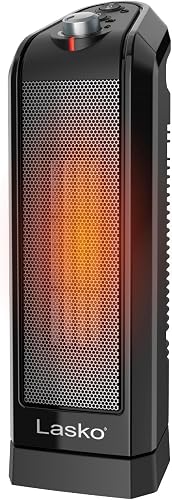
Lasko 751320 Ceramic Tower: Best for remote-controlled comfort
- Remote control
- 7-hour timer
- Wide oscillation
- ETL certified
A tall tower with a remote and timer, so you can warm the stairs or a seating area without walking over.
Pros
- Remote controls heat, oscillation and timer
- 7-hour programmable timer
- ETL certified with overheat protection
Cons
- 150 sq ft coverage
- No smart or app control
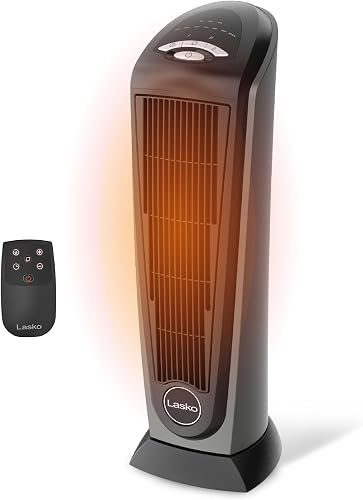
The Lasko 751320 Ceramic Tower suits anyone who wants to warm the basement without leaving the couch upstairs. Its remote controls heat settings, oscillation and the timer, so you can start it before you head down.
The 7-hour timer is a nice fit for a basement: set it and let it run while you work or watch TV, then it shuts off on its own. Wide oscillation helps spread heat across a medium room rather than blasting one spot.
The tower stands 22.5 inches tall in an 8.3-inch footprint, so it reaches up into the room while taking little floor.
Lasko says the ceramic element is self-regulating and the housing stays cool to the touch. It's ETL listed with overheat protection, which matters in a room with kids or pets.
It draws 12.5 amps and weighs just 2.5 lb, so carrying it between rooms is easy.
Coverage is 150 sq ft and the thermostat range runs 60 to 85 °F. That's narrower than the DREO's 41 to 95 °F, so it leaves less room for fine tuning.
Choose it for convenient remote control in a small to medium basement room; skip it if you need a wide thermostat range or app control.
Dr Infrared DR-968 Heater: Best for large open basements
- Dual infrared quartz and PTC heating
- 576 sq ft claimed coverage
- Electronic thermostat 50–85 °F
- Caster wheels
The biggest coverage figure here, with wheels so you can roll it to wherever the cold floor sits.
Pros
- Widest claimed coverage at 576 sq ft
- Caster wheels for moving around
- 12-hour automatic shut-off timer
Cons
- 19 lb and bulky to carry upstairs
- Thermostat stops at 85 °F
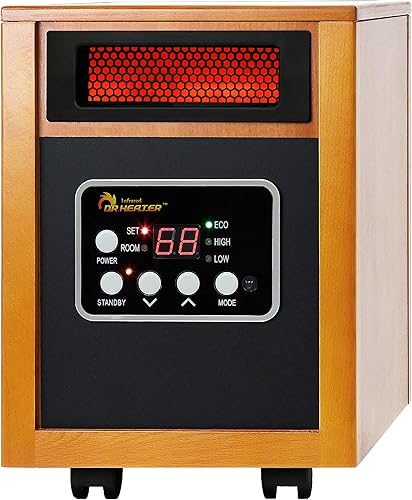
The Dr Infrared DR-968 is the pick for a large, open basement. It claims 576 sq ft of coverage, the widest here, using an infrared quartz tube plus a PTC element.
Dr Infrared says that dual setup produces about 60% more heat than a single-element heater. The unit is rated around 5200 BTU.
Caster wheels are the practical detail: you can roll it from the stairs to the far corner without carrying 19 lb. A 12-hour automatic shut-off timer and an electronic thermostat from 50 to 85 °F handle the controls, and the IR remote works from across the room.
Dr Infrared puts noise at 39 dB and includes a lifetime filter.
The trade-off is size and weight. At 19 lb and 16 inches tall in a cabinet shape, it's the bulkiest pick here and awkward to carry up and down stairs.
Its thermostat tops out at 85 °F, so it's less precise than the DREO for fine temperature control. The 6-foot cord gives you some placement room.
Choose it when your basement is big and you want one unit to cover a lot of floor.
DREO 1500W Thermostat Heater: Best for quiet finished rooms
- 34 dB quiet operation
- 70-degree oscillation
- 270 sq ft claimed coverage
- ECO mode with 12-hour timer
A slim tower that stays library-quiet, so it works in a basement office or den without drowning out conversation.
Pros
- Quiet 34 dB operation
- 270 sq ft coverage
- 70-degree wide oscillation
- ECO mode trims output automatically
Cons
- Needs a wall outlet, no extension cord
- Taller tower footprint than a tabletop model
The DREO 1500W Thermostat Heater suits a finished basement used as an office, den or guest room. It runs at 34 dB, quiet enough to sit next to a desk without drowning out a call.
DREO's fan wheel uses oblique airflow, which the brand says makes it 12% quieter than traditional electric heaters.
Its 70-degree oscillation uses a trackball system that DREO says boosts coverage by 20%, spreading warmth toward the corners of a 270 sq ft room. ECO mode adjusts output between 1000W and 1500W based on the room's temperature.
The thermostat runs from 41 to 95 °F.
Safety is well covered: V0 flame-retardant materials, tip-over protection, overheat protection, a 12-hour timer and a 24-hour automatic power-off without interaction. DREO warns against using it with an extension cord, so plan on a nearby wall outlet.
It's slim at 5.9 inches deep and 15.79 inches tall.
The trade-off is that its coverage figure depends on good airflow, and a cluttered basement blocks that. Pick it for a quiet, finished room where you want steady background warmth.
JIBUFI 17 Inches Space Heaters for Indoor: Best for quick spot heat
- 700W, 1000W and 1500W settings
- Heats in about 3 seconds
- 12-hour timer and remote
- Tip-over and overheat protection
Three power levels and a fast warm-up make it handy for taking the chill off a workbench or laundry corner.
Pros
- Three power settings for mild to cold days
- Fast 3-second heat-up
- Remote and 12-hour timer
Cons
- 200 sq ft coverage
- Remote needs 2 AAA batteries, not included
The JIBUFI 17 Inches Space Heaters for Indoor suits a basement workbench, laundry corner or home gym where you want heat fast and only for a while. Its PTC element heats in about 3 seconds, and three power settings of 700W, 1000W and 1500W let you dial down on milder days instead of running full blast.
A 12-hour timer and remote make it easy to run for a set stretch while you're working, then stop. Tip-over shutoff and overheat protection, plus ETL certification and flame-retardant materials, cover the safety side.
JIBUFI lists a 24-hour automatic power-off without interaction and a 6-foot flat cord. It also adds 70-degree oscillation to spread heat around a small zone.
Coverage is 200 sq ft and the tower stands about 16.5 inches tall in a 5.5-inch footprint. The trade-off is that the remote needs 2 AAA batteries that aren't included, and 200 sq ft won't stretch to a wide basement.
Choose it for quick, adjustable spot heat in a smaller basement zone.
AUBKN X-Large 1500W Electric Space Heaters: Best for tall towers in low rooms
- 24-inch tower height
- 70-degree oscillation
- 1–12 hour smart timer
- Tip-over and overheat shut-off
A tall, narrow tower that puts the heat outlet higher off a cold concrete floor.
Pros
- 24-inch height lifts heat off the floor
- 70-degree oscillation
- Remote control and 1–12 hour timer
Cons
- 200 sq ft coverage
- Radiant element heats surfaces more than air
The AUBKN X-Large 1500W Electric Space Heaters is a 24-inch tower, the tallest here, which puts its heat outlet higher off a cold concrete floor. That's a real advantage in a basement, where the coldest air sits at ankle level.
It's also narrow, at 5.51 inches wide, so it tucks into a corner.
It offers 70-degree oscillation, a 1–12 hour smart timer and a remote, so you can set it and forget it. Tip-over protection and overheat shut-off are built in, and AUBKN says the housing uses flame-retardant materials with ETL certification.
The heater also lists ECO modes and a thermostat, and AUBKN calls it a quiet PTC heater for an office or bedroom.
Coverage is 200 sq ft. The heating element is radiant, which warms surfaces more than the air, so it works best when you sit or work near it rather than expecting the whole room to warm evenly.
The remote needs 2 AAA batteries, not included.
The trade-off is that height: check the ceiling clearance and keep it away from low shelves. Pick it when floor heat loss is your main problem and you want a taller unit.
GiveBest Smart Wall Heater: Best for basements short on floor space
- Wall-mounted design
- WiFi app, remote and touch control
- ECO mode and precise thermostat
- ETL listed with tip-over and overheat protection
Mounts on the wall so a crowded basement keeps its floor, and the app lets you preheat before you go down.
Pros
- Saves floor space by mounting on the wall
- WiFi app control and preheat
- ECO mode with precise thermostat
Cons
- Wall mounting takes drilling and a hook template
- 200 sq ft coverage only
The GiveBest Smart Wall Heater is the pick when your basement is short on floor space. It mounts on the wall using two hooks and an included template, so a crowded laundry or storage room keeps its floor clear.
It measures about 16 inches wide by 11.4 inches tall and weighs 7.2 lb.
The 3-in-1 control gives you a WiFi app, a remote and a touch panel. The app lets you preheat before you go down, and the touch panel shows real-time room temperature.
ECO mode adjusts wattage to hold your set temperature. GiveBest lists three heating modes and a 24-hour timer.
It's ETL listed with tip-over and overheat protection and V0 flame-retardant materials. Coverage runs up to 200 sq ft at 1500W and 5200 BTUs.
The thermostat range is 40 to 99 °F. GiveBest notes that ECO mode cycles heating, so temperature swings in a poorly insulated basement, and suggests switching to P2 or P3 mode for garages or large rooms.
The trade-off is installation: you need to drill and mount it, so it's not a plug-and-go pick. Choose it for a tight basement room where wall space beats floor space.
Lasko CT16450 Console Heater: Best for simple manual control
- Two heat settings
- Manual top-mounted controls
- Wide oscillation
- ETL certified with overheat protection
No app and no remote, just two dials on top and a handle to carry it where the cold creeps in.
Pros
- Simple manual controls on top
- Built-in carry handle
- Wide oscillation for a small room
Cons
- 150 sq ft coverage
- No timer or remote
The Lasko CT16450 Console Heater is the simple pick. It has two heat settings and manual controls on top, with no app and no remote.
If you want to walk over and turn a dial, this is that heater.
Wide oscillation spreads heat across a small to medium room, and the built-in carry handle makes it easy to move between the basement and another room. Lasko says the housing stays cool to the touch and the unit is ETL listed with overheat protection.
It's compact at 15.7 inches tall and weighs 4 lb. Lasko also includes a 6-foot cord and a 3-year limited warranty.
Coverage is 150 sq ft, which is on the small side for an open basement. The trade-off is missing convenience: no timer and no remote, so you can't set it to shut off on its own or start it from upstairs.
It's a tabletop or floor unit, so placement is flexible.
Pick it when simplicity matters more than features and your basement room is small enough for 150 sq ft of coverage.
How these basement heaters compare
| Product | Best for | Heat output | Coverage | Heating element | Our score |
|---|---|---|---|---|---|
| DREO Space Heater | most basements | 1500W | 200 sq ft | PTC ceramic | 9.7 |
| Amazon Basics Oscillating Ceramic Space Heater | tight budgets | 1500W | 160 sq ft | Ceramic | 9.6 |
| Lasko 751320 Ceramic Tower | remote-controlled comfort | 1500W | 150 sq ft | Ceramic | 9.1 |
| Dr Infrared DR-968 Heater | large open basements | 1500W | 576 sq ft | Radiant infrared quartz plus PTC | 8.9 |
| DREO 1500W Thermostat Heater | quiet finished rooms | 1500W | 270 sq ft | PTC ceramic | 8.8 |
| JIBUFI 17 Inches Space Heaters for Indoor | quick spot heat | 1500W | 200 sq ft | PTC ceramic | 8.7 |
| AUBKN X-Large 1500W Electric Space Heaters | tall towers in low rooms | 1500W | 200 sq ft | Radiant | 8.3 |
| GiveBest Smart Wall Heater | basements short on floor space | 1500W | Up to 200 sq ft | PTC | 7.7 |
| Lasko CT16450 Console Heater | simple manual control | 1500W | 150 sq ft | Ceramic | 7.7 |
Our score weighs specs, features and buyer feedback against what you're shopping for. Because this is a roundup for basements, coverage and safety count most, then control convenience and noise.
The top four picks all cover 200 sq ft or more or bring a control feature a basement benefits from. The lower-scored picks are still solid; they simply solve narrower needs or offer less coverage.
A few patterns stand out across the table.
Coverage separates the field into two groups. Six heaters claim 200 sq ft or more, and the Dr Infrared DR-968 leads at 576 sq ft.
The three Lasko and Amazon Basics units sit at 150 to 160 sq ft, which suits a single finished room but not an open basement.
Thermostat range matters for a room you leave running. The DREO pair and the GiveBest go to 95 °F or higher and down to 40 or 41 °F, while the Lasko tower stops at 85 °F and the DR-968 starts at 50 °F.
A wider band gives you more control on mild and cold days.
Control style splits the list too. Seven picks include a remote, while the Amazon Basics and Lasko console rely on manual controls.
The GiveBest is the only one with WiFi and app control.
How we compared these basement space heaters
We compared these heaters on the specs that matter in a below-grade room: claimed square-foot coverage, thermostat range, heating element type, noise level and safety certification.
Every pick is a 1500W portable electric heater, so raw power is equal and the choice comes down to how each one spreads heat and how safe it is to leave running. Tip-over and overheat protection were required, and ETL listing counted in a product's favor.
DREO and GiveBest also list V0 flame-retardant materials, which we weighed as a plus.
We also weighed controls: a thermostat in 1 °F steps or an app suits a basement better than a numbered dial, because you set a target and walk away. Remote and timer features scored higher for rooms you don't sit in constantly.
The DREO's 12-hour timer and memory function, and the GiveBest's app scheduling, stood out here.
Finally, we looked at size and weight. A heater you can carry or roll to the cold corner is more useful in a basement than one that stays put.
The 2.5 to 4 lb towers scored well on this, while the 19 lb DR-968 lost points for stairs.
What should you check before buying a basement space heater?
Start with square footage and safety certification. A 1500W heater is capped by a standard household circuit, so coverage and features separate the picks more than wattage does.
A basement adds two more checks: moisture and cold floors.
How much floor area can one heater warm?
Most 1500W heaters here claim 150 to 270 sq ft, and the Dr Infrared DR-968 claims 576 sq ft. Measure your basement's usable floor area, then choose a heater whose coverage meets or slightly exceeds it.
A wide open basement needs more than one heater. The GiveBest's 200 sq ft figure also assumes a well-insulated space, so treat coverage as a guide, not a promise.
Which safety features matter most in a basement?
Tip-over protection and overheat protection are essential, and ETL listing shows the unit was tested to a safety standard. Look for V0 flame-retardant materials too.
A basement often has stored boxes and clutter, so keep the heater clear of anything flammable. Several heaters here also shut off automatically after 24 hours without interaction, which helps if you forget one is running.
If you mount a heater on a wall, follow the template and check the fixings hold.
Is a wall-mounted heater better for a small basement?
Yes, when floor space is scarce. The GiveBest Smart Wall Heater saves the floor and its app lets you preheat remotely.
The trade-off is drilling and mounting, so it's a better fit for a room you'll keep heated long-term than for a spot you warm occasionally. It also weighs 7.2 lb, so the wall fixings need to be solid.
Should you run a space heater in a damp basement?
Only after you deal with the moisture. A heater warms air but doesn't remove water, so run a dehumidifier first.
Warming damp air can make the room feel worse. If your basement takes on water, fix that before adding any electric heater.
None of the heaters here is built for drying a wet room, so moisture control comes first.
Does heater placement change how warm a basement feels?
Yes. Cold air pools at floor level, so a taller unit like the AUBKN or the Lasko tower puts heat higher and spreads it further.
Keep the heater off the cold concrete if you can, and don't block its airflow with stored items. Our space heater cleaning guide covers keeping the intake clear so airflow stays strong.
The DR-968's lifetime filter also helps keep dust out of its blower.
How long should a basement space heater last?
With regular cleaning and light use, a portable heater can last several seasons. Dust and lint are the main killers in a basement, so clean the intake and vents each month during heating season.
Our guide to how long space heaters last explains the signs it's time to replace one. Storing it dry over summer helps too.
Which basement space heater should you buy?
For most basements, buy the DREO Space Heater. Its 41–95 °F thermostat, tip-over sensor and 34 dB operation make it the best indoor space heater for basement rooms you use often but don't watch constantly.
It's the top pick overall.
Choose the Amazon Basics Oscillating Ceramic if budget is tight and the room is small. Pick the Dr Infrared DR-968 for a large open basement, the DREO 1500W Thermostat Heater for a quiet finished room, or the GiveBest Smart Wall Heater when floor space is short.
The AUBKN tower is the pick when cold floors are the problem, and the Lasko console is for anyone who just wants a dial.
If you want more detail on matching a heater to a below-grade room, read our best space heater for basement guide and the how to heat a basement walkthrough before you order.
Our top 3 picks at a glance
-
1
-
2
Best for tight budgets
Amazon Basics Oscillating Ceramic Space Heater
9.6/10 our score
See it on Amazon -
3
Frequently asked questions
What size space heater do I need for a basement?
Match the heater's claimed square-foot coverage to your basement's usable floor area. Most portable 1500W heaters here cover 150 to 270 sq ft, while the Dr Infrared DR-968 claims 576 sq ft.
Measure the room, not the whole house footprint, before choosing.
Will one 1500W space heater keep a whole basement warm?
It will warm a small to medium basement room, but not a full open basement on the coldest days. A 1500W heater is limited by a standard 15-amp circuit, so a large or poorly insulated basement needs more than one heater or a different heat source.
Is it safe to leave a space heater running in a basement?
Only if the heater is ETL listed and has tip-over and overheat protection, and you keep it clear of clutter. Don't plug it into an extension cord.
A damp basement needs a heater rated for the conditions, and you should never leave any portable heater fully unattended for long periods.
Can a space heater dry out a damp basement?
No. A space heater warms the air but doesn't remove moisture, so a damp basement stays damp.
Run a dehumidifier first, then use the heater to take the chill off the drier air.
Warming wet air without removing moisture can make the room feel worse.
Why does my basement feel cold even with the heater on?
Concrete floors and walls pull heat out of the room faster than a portable heater adds it. The AUBKN tower, with its heat outlet higher off the floor, helps a little, but insulation and a dehumidifier matter more than heater size in a below-grade room.