8 Best Space Heaters for Basements (October 2026)
The best space heaters for basements include the Dr Infrared DR-968 Heater for larger basement rooms, the De'Longhi EW7707CM Oil Heater for steady, quiet warmth, and the De'Longhi HCX9115E Panel Heater for wall mounting.
On this page (4 sections)
The Dr Infrared DR-968 Heater is our top space heater pick for a basement because it pairs infrared quartz and PTC heating with a thermostat, remote and timer. For quiet warmth, choose an oil-filled radiator; for a heater that can mount on a wall, consider the De'Longhi panel.
Basements can feel colder than the rooms above them because they often have cool floors, outside walls and less even airflow. A portable heater can warm one occupied area, but room size, insulation and electrical capacity still matter.
If you want to estimate the right output, start with our guide to space heaters for 1,000 sq ft. For a broader room-by-room plan, read how to heat a basement with a space heater.
Our picks at a glance
-
1
-
2
-
3

Which space heater is best for a basement?
The best basement heater depends on whether you value broader radiant warmth, quiet operation, wall mounting or quick airflow. The picks below are ordered by score, with the highest-scoring option first.
We compared each heater's stated power, heat style, controls and safety features. Our score weighs specs, features and buyer feedback against what you're shopping for.
| Product | Best for | Power | Heating style | Controls | Our score |
|---|---|---|---|---|---|
| Dr Infrared DR-968 Heater | larger basement rooms | 1500 watts, 12.5 amps | Infrared quartz and PTC | 50 to 85 F thermostat, remote, 12-hour timer | 8.9 |
| De'Longhi EW7707CM Oil Heater | steady, quiet warmth | 1500 watts, 12.5 amps | Oil-filled radiator | Three heat settings, adjustable thermostat | 8.6 |
| De'Longhi HCX9115E Panel Heater | wall mounting | 1500 watts, 12.5 amps | Convection with dual lateral fans | Digital thermostat, 24-hour timer | 7.8 |
| Pelonis Oil-Filled Radiator | scheduled warmth | 900 or 1500 watts, 12.5 amps | Oil-filled radiator | Five temperature settings, LCD, remote | 8.3 |
| Amazon Basics Oil Heater | simple controls | 600, 900 or 1500 watts | Oil-filled radiator | Manual thermostat and three heat settings | 7.8 |
| Comfort Zone Oil-Filled Heater | lower wattage | 500, 700 or 1200 watts, 10 amps | Oil-filled radiator | Manual thermostat and three heat settings | 7.6 |
| Costway 1500W Oil Heater | movable radiator heat | 600, 900 or 1500 watts, 12.5 amps | Oil-filled radiator | Knob thermostat and three modes | 7.4 |
| DREO 25 Inch Tower Heater | quick, directed heat | 1500 watts, 16 amps | PTC ceramic forced air | Four modes, 1 F temperature steps | 8.5 |
Best space heaters for basements
The Dr Infrared DR-968 Heater is the highest-scoring pick for basement use, with the DREO tower next for directed airflow. The other heaters suit quieter use, lower wattage or specific placement needs.
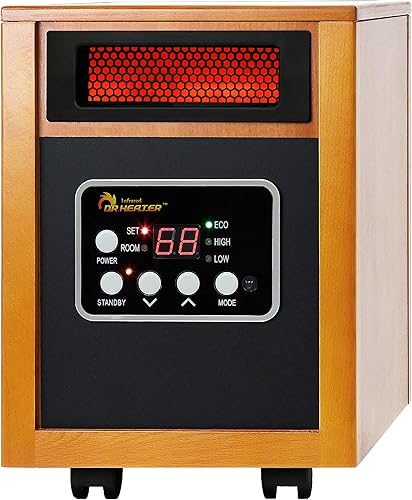
Dr Infrared DR-968 Heater: Best for larger basement rooms
- Infrared quartz and PTC heating
- 1500 watts
- 50 to 85 F thermostat
- Tip-over and overheat protection
The dual heating system and remote suit a larger basement room where you want radiant warmth and adjustable controls. It is a freestanding cabinet with caster wheels.
Pros
- Dual infrared and PTC heating
- Remote and 12-hour timer
- Tip-over and overheat protection
Cons
- Needs floor space
- Uses 12.5 amps at its rated power
The Dr Infrared DR-968 Heater combines an infrared quartz tube with PTC heating. It is rated at 1500 watts and 12.5 amps, with a thermostat range of 50 to 85 F.
The remote and 12-hour automatic shut-off timer make it easier to adjust from a desk or sofa. Caster wheels help you move the 19 lb cabinet, and it has tip-over and overheat protection.
Its radiant heat can suit a larger basement room where you want warmth beyond a narrow stream of air. The 6 ft power cord may limit placement, so set it near an appropriate outlet and keep the cord away from walkways.
Choose it if you want multiple controls and a dual heating system in one portable cabinet. It draws 12.5 amps, so check what else shares the circuit before use.
DREO 25 Inch Tower Heater: Best for quick, directed heat

- 1500 watts
- 70-degree oscillation
- Temperature range 41 to 95 F
- Tip-over and overheat protection
The tower sends warm air around a room with 70-degree oscillation and offers four modes. Its stated coverage is 100 to 270 sq ft, so check the room size before choosing it.
Pros
- 70-degree oscillation
- Precise temperature settings
- Child lock and safety shutoffs
Cons
- Draws 16 amps
- Fan sound and airflow may not suit everyone
The DREO 25 Inch Tower Heater is the quick-airflow choice for a basement spot where you want heat directed around the room. Its 70-degree oscillation spreads warm air, and four modes include three heat levels and ECO.
The thermostat can be set from 41 to 95 F in 1-degree steps. DREO states coverage of 100 to 270 sq ft, so this is better suited to a defined room or zone than an entire unfinished basement.
Safety features include flame-retardant material, a reinforced plug, tip-over and overheat protection, plus a child lock. Its listed amperage is 16 A, so verify the outlet and circuit can support that draw.
Choose it for directed airflow and precise temperature settings in a smaller zone. Consider whether its fan noise and airflow suit your space.
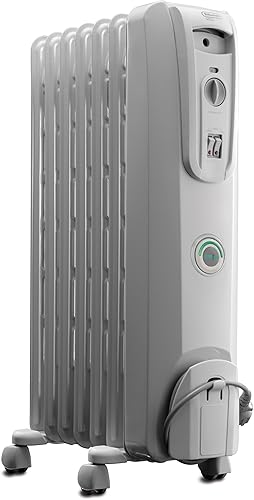
De'Longhi EW7707CM Oil Heater: Best for steady, quiet warmth
- 1500 watts
- ComfortTemp feature
- No fan
- Thermal cut-off
This oil-filled radiator gives quiet heat without a fan stirring air. Its built-in handle and wheels make it easier to move between rooms.
Pros
- Quiet operation without a fan
- ComfortTemp feature
- Sealed oil reservoir needs no refilling
Cons
- Slow to warm compared with fan heaters
- Takes up floor space
The De'Longhi EW7707CM Oil Heater is a good fit for a basement office or sitting area where quiet operation matters. The oil-filled radiator heats without a fan to stir dust and dander.
Its ComfortTemp feature is designed to maintain a comfortable temperature and power level. Three heat settings and an adjustable thermostat give you control, while the permanently sealed oil reservoir needs no refilling.
The radiator weighs 23.2 lb and has an integrated handle and wheels for room-to-room movement. Its thermal cut-off and enclosed heating elements are safety features, but it still needs clear space around it.
Pick it for steady, quiet warmth in an occupied room. It is less suited to someone who wants warm air to blow across the basement right away.
Pelonis Oil-Filled Radiator: Best for scheduled warmth

- 900 or 1500 watt settings
- 10-hour timer
- Remote control
- Tip-over and overheat protection
The timer and remote help when the heater sits across a finished basement room. Its radiator design provides quiet warmth but takes time to heat up.
Pros
- 10-hour timer and remote
- Two power levels
- Quiet operation
Cons
- Slower warm-up than a fan heater
- Temperature choices stop at 85 F
The Pelonis Oil-Filled Radiator offers controls that are useful when you want to set a temperature without standing beside the heater. It has a remote, LCD, programmable thermostat and 10-hour timer.
Choose between 900 and 1500 watts, then select one of five temperatures from 65 to 85 F. Four swivel caster wheels help move it between a basement room and other indoor spaces.
Oil-filled heat takes longer to build than fan heat, but the unit operates quietly. Its tip-over switch and overheat protection are safety features if it is knocked over or runs too hot.
Choose it for quiet heat with a timer and remote. If you only need short bursts of warmth, a fan heater may feel more responsive.
Dr Infrared DR-968 Heater: Best for larger basement rooms
- Infrared quartz and PTC heating
- 1500 watts
- 50 to 85 F thermostat
- Tip-over and overheat protection
The dual heating system and remote suit a larger basement room where you want radiant warmth and adjustable controls. It is a freestanding cabinet with caster wheels.
Pros
- Dual infrared and PTC heating
- Remote and 12-hour timer
- Tip-over and overheat protection
Cons
- Needs floor space
- Uses 12.5 amps at its rated power
The De'Longhi HCX9115E Panel Heater works for a basement where floor space is limited. It can stand on its feet or mount to a wall with the included kit, and its dual lateral fans help move warm air through a room.
The digital controls include an adjustable thermostat, multiple heat settings and a 24-hour timer. The anti-freeze setting switches on below 41 F and can help prevent frozen pipes.
The panel is rated at 1500 watts and 12.5 amps. It has a thermal shutoff and an internal tip-over switch, while wall mounting still requires a nearby outlet and safe clearance.
Choose it if you want a low-profile heater with a timer and flexible mounting. A fan-based panel may be less appealing if you want quiet heat.
Amazon Basics Oil Heater: Best for simple controls

- 600, 900 and 1500 watt settings
- Adjustable thermostat
- Seven oil-filled fins
- Tip-over and overheat protection
Manual controls keep setup simple, and three power levels let you choose a lower setting when full output is unnecessary. The oil-filled design has no fan.
Pros
- Three power levels
- Quiet, fan-free heating
- Caster wheels and handle
Cons
- No remote or timer
- Manual controls require reaching the unit
The Amazon Basics Oil Heater keeps operation simple with a manual thermostat and three power settings: 600, 900 and 1500 watts. Its seven oil-filled fins release heat without a fan.
Caster wheels and a handle help with moving the radiator from storage to the area you use. The heater has tip-over and overheat protection, and its sealed oil requires no refilling.
This is a practical option if you don't need a remote, timer or digital display. Keep the heater away from damp areas and stored items, even when its quiet operation makes it easy to forget it's on.
Pick it for straightforward controls and quiet heat. Consider another model if you need to schedule operation or change settings from across the room.
Comfort Zone Oil-Filled Heater: Best for lower wattage

- 500, 700 and 1200 watt settings
- Adjustable thermostat
- Tip-over switch
- Overheat protection
Its 1200-watt maximum draws less current than a 1500-watt heater at full power. The compact radiator is intended for medium-sized rooms.
Pros
- Lower maximum wattage
- Three heat settings
- Tip-over and overheat protection
Cons
- No remote or timer
- Less maximum output than 1500-watt options
The Comfort Zone Oil-Filled Heater is the lower-wattage pick in this group, with 500, 700 and 1200 watt settings. At its top setting, it draws 10 amps, which can make it easier to fit into a circuit with other loads than a 1500-watt heater.
Its adjustable thermostat and three heat levels let you reduce output when the room is already warm. The radiator is described for medium-sized rooms and has a tip-over switch and overheat protection.
Oversized rear wheels help move the 15.8 lb heater, while its slim body takes up less floor area than a wider radiator. It has no remote or timer, so you'll adjust it at the unit.
Choose it when a lower maximum wattage is useful for your circuit or room. Its 1200-watt ceiling may be too low for a large, cold basement.
Costway 1500W Oil Heater: Best for movable radiator heat

- 600, 900 and 1500 watt settings
- Adjustable thermostat
- Four caster wheels
- Tip-over and overheat shutoff
Four caster wheels and a front handle help move this radiator between basement areas. Its knob controls are straightforward, though it has no stated timer.
Pros
- Three power settings
- Caster wheels and carry handle
- Tip-over and overheat shutoff
Cons
- No stated timer or remote
- Maximum setting uses 12.5 amps
The Costway 1500W Oil Heater has three modes at 600, 900 and 1500 watts, plus an adjustable thermostat. Four caster wheels and a front handle make it easier to roll between basement areas.
Its sealed oil reservoir does not need extra oil, and it is described as quiet. Tip-over and overheat shutoffs are included, along with a design intended to keep the surface temperature low.
The knob controls are simple, and the available product information does not mention a timer or remote. At the maximum setting it draws 12.5 amps, so account for other equipment on the circuit.
Pick it if you want a movable radiator with simple settings. If timing or remote control matters, the Pelonis offers both.
How do you choose a basement space heater?
Choose a basement heater by matching the room's size, heat style and outlet circuit. A large open basement may need more than one zone, while a finished room with a closed door can be easier to heat as a single space.
How much space can a basement heater cover?
A heater's stated coverage is a starting point, not a promise that it will warm every basement evenly. Coverage claims assume room conditions that may differ from your basement's insulation, ceiling height and layout.
The DREO tower states 100 to 270 sq ft of coverage, while the Dr Infrared's specs state 576 sq ft. Compare those figures with the room you plan to heat, and keep doors or stair openings in mind.
For a more detailed sizing approach, see our guide to choosing a heater for 1,000 sq ft. Don't assume one portable heater will heat a whole basement with separate rooms or large drafts.
Should you choose radiant heat or a fan heater?
Radiant and oil-filled heaters provide heat without the same forced airflow as a tower fan heater. A fan heater can move warm air around sooner, while an oil radiator tends to warm gradually and continue releasing heat after cycling.
For a basement work area, airflow can help when you arrive to a cold room. For a quiet reading or sitting area, the De'Longhi EW7707CM or Pelonis radiator avoids fan noise.
Learn how infrared heaters work if you're considering radiant warmth. The DR-968 combines infrared and PTC elements, so it differs from a basic oil-filled radiator.
What electrical limits should you check?
Check the heater's amperage and the other devices on its circuit before use. A 1500-watt heater can draw 12.5 amps at 120 volts, while the DREO tower's listed amperage is 16 A.
Follow the heater's instructions for outlet use and avoid overloading the circuit. If the breaker trips, stop using the setup and look into the circuit; our guide to why a space heater trips the breaker explains common causes.
What safety features matter in a basement?
Tip-over and overheat shutoffs are useful safeguards, but placement and supervision still matter. Set the heater on a flat, dry surface, keep it away from laundry and storage, and leave open space around air intakes and outlets.
Plug the heater directly into a wall outlet and keep the cord visible and clear of paths. For a longer checklist, read what tip-over protection does.
Basements can also hold damp air or water after leaks, so keep a portable electric heater away from standing water. If moisture is a regular issue, address that first and use the heater only in a dry area.
Which basement space heater should you choose?
Choose the Dr Infrared DR-968 Heater for its dual infrared and PTC system, remote and timer. Pick the DREO tower for directed airflow, the De'Longhi EW7707CM for quiet, gradual warmth, or the HCX9115E when wall mounting and scheduled operation matter.
For a basement corner or office, match the heater to the occupied zone and check the outlet circuit before plugging it in. If you're planning a whole-room setup, start with how to heat a basement with a space heater.
Our top 3 picks at a glance
-
1
-
2
-
3
Frequently asked questions
What kind of space heater works best in a basement?
An oil-filled radiator suits quiet, steady warmth, while a fan or panel heater moves warm air sooner. For a larger room, compare the heater's stated coverage with your basement's usable area and insulation.
A portable electric heater is supplemental heat, not a replacement for fixing drafts or a faulty central heating system.
How many watts do I need to heat a basement?
There is no single wattage that fits every basement because ceiling height, insulation, drafts and room layout affect heat loss. Many portable heaters in this guide use up to 1500 watts, but that does not guarantee they can heat an entire basement.
For a larger or divided space, estimate each area separately and consider the building's main heating system.
Can I leave a space heater running in a basement?
Use a space heater only as its instructions allow, on a stable, level surface with clear space around it. Keep it away from water, laundry, stored items and combustible materials, and plug it directly into a suitable wall outlet.
Don't leave a portable heater unattended or running while you sleep.
Why does a basement space heater trip the breaker?
A heater may trip a breaker when its electrical load combines with other devices on the same circuit, or when there is a wiring or equipment fault. A 1500-watt heater can draw 12.5 amps at 120 volts.
Unplug it and investigate the circuit before using it again.
See our guide to space heaters tripping breakers for next steps.
Should I use an oil-filled heater or a ceramic heater in a basement?
Choose an oil-filled radiator for quiet warmth that lingers after the unit cycles off. Choose a ceramic fan heater when you want warm air directed into the room sooner.
For a basement used only for short visits, faster airflow may feel useful.
For a work or sitting area, quiet operation may matter more.


