9 Best Space Heaters for a Large Basement (November 2026)
The best space heaters for large basements include the Lasko 751320 Ceramic Tower (best overall for open basement rooms), the PELONIS 23” Oscillating Ceramic Tower Space Heater for energy-saving basement use, and the Dr Infrared DR-968 Heater for the largest coverage.
On this page (5 sections)
The best space heater for a large basement is the Lasko 751320 Ceramic Tower, because its 1500W ceramic element and wide oscillation spread warm air across an open room without a heavy cabinet in the way. Choose the PELONIS 23” tower when power bills matter, the Dr Infrared DR-968 when coverage is the priority, or the De'Longhi oil heater for silent evenings.
A basement is a hard room to heat. Concrete walls pull warmth out fast, and one 1500W heater has to fight that loss.
The right pick is the one whose coverage, airflow and noise fit how you actually use the space.
This guide skips the basics covered in our space heater for basement roundup. Instead it looks at what changes when the room is large: how far a heater's warm air actually reaches, how to split a big floor between units, and which heating type suits a basement you use at night.
If you're starting from scratch on placement and wiring, read how to heat a basement first.
Our picks at a glance
-
1
-
2
 Best for energy-saving basement use
PELONIS 23” Oscillating Ceramic Tower Space Heater
9.1/10 our score
See it on Amazon -
3
- 4
 Best for a small basement office nookCheck it
- 5
 Best for silent whole-evening heatCheck it
- 6
 Best for tall basement roomsCheck it
- 7
 Check it
Lifeplus 1500W Electric Infrared Space Heater
Best for spot warmth in a damp corner - 8
 Check it
AUBKN X-Large 1500W Electric Space Heaters
Best for budget basement heating - 9
 Best for freeing up basement floor spaceCheck it
The best space heaters for a large basement
The Lasko is the strongest overall for most basements because it balances coverage, weight and control. The rest of the picks win on a specific need, from the widest coverage claim to quiet overnight warmth.
Every unit here is 1500W, so the real differences are airflow, thermostat precision and how much floor each one takes.
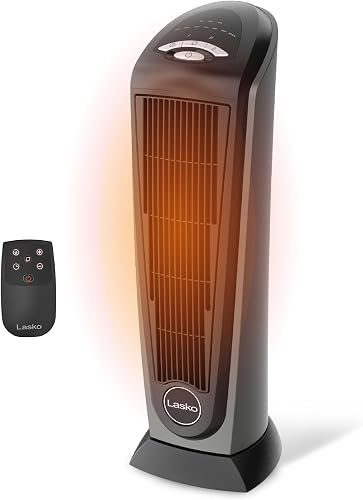
Lasko 751320 Ceramic Tower: Best overall for open basement rooms
- 1500W ceramic forced-air heating
- Widespread oscillation
- 7-hour timer and remote
- Overheat protection
A light tower that moves easily between basement zones and spreads heat with wide oscillation.
Pros
- Widespread oscillation
- Remote and 7-hour timer
- Only 2.5 lb
Cons
- Forced air moves dust
- Shortest warranty details in this group
The Lasko 751320 suits a basement where you move around: a finished rec room, a laundry corner you pass through, or a workspace that shifts with the seasons. At 2.5 lb, it's the lightest tower here, so carrying it from one cold zone to another is easy.
Its ceramic element heats air and pushes it out through wide oscillation, which is why it works better in an open basement than a radiant panel that only warms what faces it. The thermostat runs from 60 to 85 F and the remote handles the heat settings, oscillation and the 7-hour timer, so you can set it before you head down the stairs.
The tower stands 22.5 in tall and only 7.25 in wide, so it slips beside a sofa or a storage shelf without blocking the walkway. Two heat settings keep it simple.
Its coverage fits a medium room, not an entire open floor, and the forced air will move dust in a basement that hasn't been cleaned in a while, so run a vacuum first.
Buy it for everyday basement use in one main zone. Skip it if your basement is wide open and you need heat spread across 500+ sq ft from one spot.
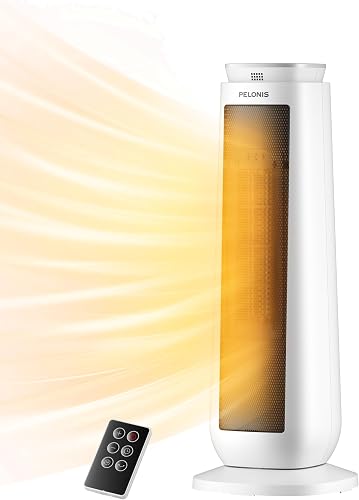
PELONIS 23” Oscillating Ceramic Tower Space Heater: Best for energy-saving basement use
- 1500W PTC ceramic heating
- ECO mode and thermostat
- 70-degree oscillation
- 8-hour timer and remote
ECO mode trims power as the room warms, which suits a basement you heat for long stretches.
Pros
- ECO mode saves power
- 70-degree oscillation
- Carry handle
Cons
- Noisier than the quietest picks
- Needs a standard outlet with no extension cord
PELONIS is the pick for a basement you heat for hours at a time. Its ECO mode reads the room and trims power as the space warms, so the heater isn't pulling full 1500W the whole evening.
The 1500W PTC element heats fast and holds a steady temperature.
The 70-degree oscillation is slightly wider than the Lasko's, and the 8-hour timer covers a long basement session. A carry handle makes it easy to move.
The touch controls and remote both handle the thermostat and timer. At about 52 dB it's clearly audible, so it's better for a work area than a spot next to a TV.
One setup point matters in a basement: PELONIS says to plug it into a standard socket without an adapter or extension cord. A basement with few outlets may need an electrician before this heater makes sense.
The spec sheet lists 167-200 sq ft while the description lists 160 sq ft, so treat 160 as the safe planning size.
Choose it when energy saving and a long timer matter more than near-silent running.
Dr Infrared DR-968 Heater: Best for the largest coverage
- Infrared quartz tube plus PTC
- 12-hour auto shut-off
- Electronic thermostat 50 to 85 F
- Caster wheels
The widest coverage claim here, with wheels so you can roll it to the cold corner of a big basement.
Pros
- Widest stated coverage
- Caster wheels
- 12-hour shut-off
Cons
- 19 lb to move on stairs
- Cabinet shape takes more floor space
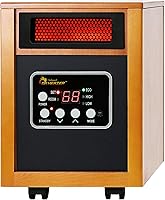
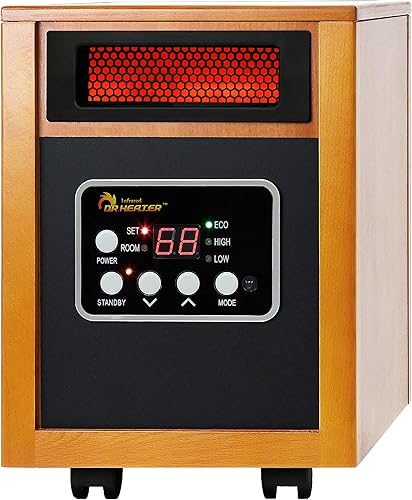
The Dr Infrared DR-968 is the pick when raw coverage is your main concern. It combines an infrared quartz tube with a PTC element and states 5200 BTU and up to 576 sq ft, the widest figure in this group.
That makes it the one to consider for a large open basement.
Its dual heating system blends radiant warmth with blown air, and the blower is rated at 39 dB. Caster wheels matter in a basement: you can roll it from the stairs to the far corner without lifting 19 lb.
The 12-hour auto shut-off and thermostat from 50 to 85 F suit long sessions. A lifetime filter and a 72-inch cord round out the package.
The trade-off is bulk. The cabinet measures 13 x 11 x 16 in, so it takes more floor space than a tower, and 19 lb is heavy on stairs.
It also leans on radiant heat, so it warms what it faces more than the air behind you. Its dry radiant heat suits a large open room better than a small closed corner.
Pick it for the biggest single-room coverage, especially if you can leave it on wheels in one place.
DREO 16 Inch Tower Heater: Best for a small basement office nook
- 1500W PTC ceramic heating
- 70-degree oscillation
- 24-hour auto-off
- Digital thermostat 41 to 95 F
A short tower that heats a desk corner quietly without taking up much floor.
Pros
- Quiet 34 dB operation
- Precise 1 F thermostat steps
- Compact 16 in height
Cons
- Covers less area than the big picks
- Short tower needs to sit near the desk
The DREO 16 Inch is the pick for a basement desk corner or a small finished nook. It's only 15.83 in tall, so it tucks beside a chair or under a shelf, and its 70-degree oscillation spreads heat across a workspace rather than one spot.
Its base is 6.38 x 6.1 in, so it needs very little floor.
What sets it apart is quiet. DREO says noise drops as low as 34 dB, and the digital thermostat adjusts in 1 F steps from 41 to 95 F.
That precision helps in a basement where the temperature swings between a cold morning and a warmer afternoon. The 12-hour timer and ECO mode let you run it through a workday without touching it.
Its stated coverage runs 107.6 to 215.3 sq ft, so it's not the unit for a whole open floor. It also draws 16 A, which means checking that your basement outlet is on a dedicated circuit.
At 5.1 lb it's easy to carry up and down stairs.
Choose it when you work or relax in one basement corner and want the heater to disappear into the background.
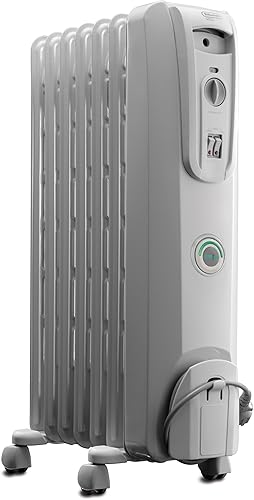
De'Longhi EW7707CM Oil Heater: Best for silent whole-evening heat
- 1500W oil-filled radiator
- ComfortTemp energy saving
- Three heat settings
- Anti-freeze setting
A fan-free radiator that keeps radiating after it cycles off and runs without any blower noise.
Pros
- No fan, so no dust blowing
- ComfortTemp saves power
- Anti-freeze setting
Cons
- 23.2 lb to move
- Slow warm-up compared with ceramic
The De'Longhi EW7707CM suits a basement living area used in the evening. It's an oil-filled radiator with no fan, so it makes no blower noise and doesn't stir up dust.
That matters in a basement with carpet, stored boxes or a musty smell.
Its ComfortTemp feature automatically holds the set temperature and power level, and De'Longhi says that saves up to 20% versus leaving the thermostat at max. The thermal slot design keeps the surface cooler while heat flows into the room, and the anti-freeze setting switches on below 44 F.
That's useful in a basement that dips when nobody is home. Three heat settings and a 27-inch-tall steel body with smart snap wheels give it a furniture-like footprint.
Radiant oil heat is slow to warm a cold concrete room and takes time to get going. At 23.2 lb with wheels, it's movable but not light on stairs.
It also runs dry heat only through the oil reservoir, so there's no blower to push warmth into a far corner.
Pick it for silent, steady heat in a basement den, and accept the slower start.
DREO 25 Inch Tower Heater: Best for tall basement rooms
- 1500W PTC ceramic heating
- 70-degree oscillation
- Child lock
- 25 dB quiet operation
A taller tower that lifts warm air higher and covers more floor than the 16-inch DREO.
Pros
- Covers up to 270 sq ft
- 25 dB quiet
- Child lock
Cons
- 16 A draw needs a dedicated circuit
- 7.3 lb is heavier than the short DREO
The DREO 25 Inch is the taller tower for a basement with high ceilings or a long wall. At 25 in it lifts warm air higher than the short DREO, and its extended impeller doubles the heat range, with coverage stated at 100 to 270 sq ft.
It's also the quietest large pick here at 25 dB, and it adds a child lock, which helps in a basement where kids play. The 1 F thermostat runs from 41 to 95 F with four modes (H1, H2, H3 and ECO), plus a fan-only setting to circulate air when the room is too warm.
A remote and a 70-degree oscillation arc round it out.
The 16 A draw is the catch: confirm your basement circuit before you buy. At 7.3 lb and 25 in tall it's heavier and bulkier than the 16-inch model, though still easy enough to move.
Its base is 7.87 x 7.87 in, so plan a little floor clearance.
Choose it when you need more reach and near-silent running in a tall or wide basement room.
Lifeplus 1500W Electric Infrared Space Heater: Best for spot warmth in a damp corner
- 1500W infrared quartz heating
- Three heat settings
- 12-hour timer and remote
- Tip-over and overheat protection
Infrared warmth that heats objects and people nearby, useful where you sit rather than the whole room.
Pros
- Warms people and surfaces fast
- 12-hour timer
- Child lock
Cons
- Heats a spot, not the whole room
- 16.3 lb cabinet
The Lifeplus infrared cabinet is the pick for spot warmth where you sit. Infrared heats objects and people in its path rather than the air around it, so it's the right tool for a cold corner where you read or work, not for warming an entire open floor.
It has three settings (750W, 1500W and ECO), a 12-hour timer and a remote, plus tip-over and overheat protection. The LED display and digital thermostat make the set temperature easier to hold than a dial.
A child lock adds a layer of safety in a family basement. The cabinet measures 11.93 x 12.8 x 15.79 in and weighs 16.3 lb.
The maker notes a faint plastic odor on first use that fades after one or two runs. Place it at least 3 feet from walls and stored items.
It draws about 13.64 A, slightly more than the 12.5 A towers, so check the circuit.
Buy it when you want fast, directed warmth at one seat. Skip it if your goal is to raise the whole basement's temperature.
AUBKN X-Large 1500W Electric Space Heaters: Best for budget basement heating
- 1500W PTC ceramic heating
- 1 to 12 hour timer
- 70-degree oscillation
- Remote control
A 24-inch tower with a remote and timer at a budget-friendly tier for smaller basement rooms.
Pros
- Remote and 12-hour timer
- 24-hour auto power off
- 6 ft power cord
Cons
- Covers about 200 sq ft
- AAA batteries for the remote not included
The AUBKN is the budget-friendly pick for a smaller basement room. It's a 24-inch ceramic tower with a remote, a 1 to 12 hour timer and 70-degree oscillation, and it states coverage of about 200 sq ft.
Three speeds and an ECO mode let you match the heat to the day.
That coverage fits a single finished room, a home gym corner or a laundry area. The 6 ft flat power cord helps when the nearest outlet is across the floor.
A 24-hour auto power-off adds a safety layer for a heater left running. ETL listing plus tip-over and overheat shut-off cover the basics.
The tower is 23.09 in tall and just 5.51 in wide, so it fits narrow gaps.
The remote needs two AAA batteries that aren't included. And 200 sq ft is the ceiling here: it's not the heater for a wide open basement.
Its 12.5 A draw works on a standard 15 A circuit.
Choose it when the budget is tight and the room is modest. For a bigger floor, the DR-968 or DREO 25 Inch covers more ground.
GiveBest Smart Wall Heater: Best for freeing up basement floor space
- 1500W PTC wall-mounted heater
- WiFi, remote and touch control
- ECO mode and thermostat
- Tip-over and overheat protection
Hangs on the wall to keep floor clear, which helps in a basement crowded with storage.
Pros
- Saves floor space
- WiFi app and remote control
- 24-hour timer
Cons
- Needs wall drilling
- Not for rooms over 200 sq ft
The GiveBest wall heater is the pick when floor space is the problem. Basements collect storage, and a wall-mounted unit keeps the floor clear.
It has WiFi, a remote and a touch panel, so you can preheat the room from upstairs. It measures 16 x 11.4 in and weighs 7.2 lb, so the wall mount is easy to handle.
The ECO mode and precision thermostat hold a set temperature and trim wattage to save power. It's rated for up to 200 sq ft, so it suits a basement bathroom, a laundry room or a small office rather than a wide open floor.
It runs up to 5200 BTU and covers 40 to 99 F on the thermostat. GiveBest also notes the tip-over protection stops heating but keeps the fan running to clear residual heat, which is normal.
Installing it means drilling into the wall, so plan the spot carefully. Once mounted, it stays put.
It draws 12.5 A on a standard circuit.
Buy it when you need basement heat without giving up floor, and the room is under 200 sq ft.
How these basement heaters compare
Every heater here runs at 1500W, so the differences that matter are how far the warm air reaches, how much noise it makes, and whether it needs wall space or floor space. The table lines up the specs that decide those trade-offs.
| Product | Best for | Heat output | Size (D x W x H) | Weight | Our score |
|---|---|---|---|---|---|
| Lasko 751320 Ceramic Tower | overall for open basement rooms | 1500W | 8.3 x 7.25 x 22.5 in | 2.5 lb | 9.1 |
| PELONIS 23” Oscillating Ceramic Tower Space Heater | energy-saving basement use | 1500W | 7.17 x 7.17 x 22.95 in | 9.1 | |
| Dr Infrared DR-968 Heater | the largest coverage | 5200 BTU | 19 lb | 8.9 | |
| DREO 16 Inch Tower Heater | a small basement office nook | 1500W | 8.6 | ||
| De'Longhi EW7707CM Oil Heater | silent whole-evening heat | 1500W | 6.5 x 15.5 x 27 in | 23.2 lb | 8.6 |
| DREO 25 Inch Tower Heater | tall basement rooms | 1500W | 8.5 | ||
| Lifeplus 1500W Electric Infrared Space Heater | spot warmth in a damp corner | 1500W | 11.93 x 12.8 x 15.79 in | 16.3 lb | 8.4 |
| AUBKN X-Large 1500W Electric Space Heaters | budget basement heating | 1500W | 8.3 | ||
| GiveBest Smart Wall Heater | freeing up basement floor space | 1500W | 7.7 |
Our score weighs specs, features and buyer feedback against what you're shopping for.
Heating type at a glance
Ceramic towers heat air and push it out, so they warm a room's air faster than radiant models. That's why the Lasko, PELONIS and both DREO towers are the best fit for a large open basement.
Infrared models warm people and surfaces in their path, so they suit a seat or a cold corner. Oil-filled radiators give silent, steady radiant heat and keep giving it after the power cycles off.
For a wide open floor, start with a ceramic tower. For a den or reading nook, the oil radiator or an infrared unit is the calmer choice.
Noise and airflow differences
Noise runs from 25 dB on the DREO 25 Inch up to about 52 dB on the PELONIS. The oil radiator and infrared cabinet are quieter still because they have no blower, but they also move less air.
If the basement is also a TV room or a home office, put the quietest tower nearest the seats. If you just need warmth spread through an open space, a louder tower with wider oscillation does the job.
How we compared these heaters for a large basement
We started with coverage. A basement is typically the largest unheated room in a house, so we weighed each unit's stated square footage against how it moves air: forced air for towers, radiant heat for infrared and oil models.
Where a spec sheet listed a range, we used the lower figure as the safe planning size.
Next came the practical fit. Weight and wheels decide whether you can move a heater between basement zones.
Height and base size decide whether it fits beside storage or a stair landing. Noise decides whether it belongs near a TV or a desk.
Thermostat precision decides how steady the room stays through a long evening.
Then we checked the safety and power details that matter in a basement: ETL listing, overheat and tip-over protection, and the amp draw. Most units here pull about 12.5 A on a standard 15 A circuit, while the two DREO towers draw 16 A and need a 20 A circuit.
That changes what your breaker panel can handle. Finally, we matched each heater to the buyer most likely to want it.
What to check before you buy a basement space heater
How many square feet can one 1500W heater actually warm?
About 150 to 270 sq ft for a typical ceramic tower, depending on the model and how open the room is. That's a zone, not a whole basement.
A 1,000 sq ft open floor needs two heaters in separate spots on separate circuits. The DR-968 states 576 sq ft, the widest figure here, but even that is a claim for one heated area, not a guarantee for a whole floor.
Plan by the smaller end of any range a spec sheet gives.
Does a basement need a different heater type than an upstairs room?
A ceramic tower is the easiest all-round fit because it moves warm air around a large space. Infrared suits a cold corner where you sit, since it heats surfaces and people directly.
An oil-filled radiator suits a basement den used for long, silent evenings. The best indoor space heater for basement guide goes deeper on each type if you're still deciding.
The main basement twist is the cold slab: warm air rises away from it, so a tower that keeps air moving beats a panel that only warms what it faces.
What size circuit does a 1500W basement heater need?
A 1500W heater draws about 12.5 A, so it needs a 15 A circuit with nothing else heavy on it. Some models here, including the DREO 16 Inch and DREO 25 Inch, draw 16 A and need a 20 A circuit.
Check the breaker before you buy. Never run a basement heater on an extension cord or power strip.
A heater rated 12.5 A leaves little headroom on a shared basement circuit with a freezer or dehumidifier.
Should you pick a tower or a wall heater for a basement?
A tower wins when you want portable heat you can move between zones. A wall heater wins when the basement floor is crowded with storage.
The GiveBest wall unit frees the floor but needs drilling and covers only up to 200 sq ft. Most large basements do better with a portable tower plus a second unit for the far end.
If the room has one seating area and little floor, the wall mount is the tidy choice.
What safety features matter most in a basement?
Overheat protection and tip-over shut-off come first, because basements have clutter and uneven floors. An ETL listing confirms the unit was tested to a recognized standard.
A child lock helps in a family basement. Place any heater at least 3 feet from walls, boxes and curtains, and keep it off carpet edges where it could tip.
In a basement with a low ceiling or exposed joists, keep the top clear so heat has room to rise.
How do you keep a basement heater working well all winter?
Clean the intake and vents regularly, since basements are dustier than upstairs rooms. Our guide on how to clean a space heater covers the steps for ceramic, infrared and oil models.
Also seal obvious drafts and put a rug over cold concrete so the heat you pay for stays in the room. If the basement smells musty, run a dehumidifier alongside the heater rather than relying on heat to dry the air.
Which space heater should you buy for your basement?
For most large basements, buy the Lasko 751320. It's light enough to move between zones, its wide oscillation spreads heat across an open room, and the remote and timer make it easy to run.
For a very wide floor, the Dr Infrared DR-968 covers more ground on wheels. For long, silent evenings, the De'Longhi oil radiator is the calm choice.
Pick by the job: a desk corner needs the quiet DREO 16 Inch, a power-conscious household needs the PELONIS ECO mode, and a crowded floor needs the GiveBest wall heater. Whatever you choose, measure your basement's usable area first.
The best space heater for a large basement is the one sized to the zone you actually sit in, not the whole concrete floor.
Our top 3 picks at a glance
-
1
-
2
Best for energy-saving basement use
PELONIS 23” Oscillating Ceramic Tower Space Heater
9.1/10 our score
See it on Amazon -
3
Frequently asked questions
How many watts do I need to heat a large basement?
A 1500W heater is the practical maximum for a standard 15-amp household circuit. It covers roughly 150 to 270 sq ft depending on the model.
For a basement much larger than that, use two heaters on separate circuits rather than one unit run at full power.
Will a space heater heat a whole basement?
One 1500W heater warms a zone, not an entire open basement. Place it where you sit or work and close nearby doors to hold the heat.
For a wide finished basement, two smaller heaters in separate spots beat one large unit.
What kind of space heater works best in a basement?
A ceramic tower is the easiest all-round pick for a basement because it moves warm air across the room with oscillation. Infrared suits spot warmth where you sit, and oil-filled radiators suit long, silent evening use.
Can I run a basement space heater on an extension cord?
No. A 1500W heater draws about 12.5 amps and should plug directly into a wall outlet rated for it.
An extension cord or power strip can overheat under that load.
PELONIS also tells buyers to use a standard socket without an adapter or extension cord.
Why does my basement feel cold even with a heater running?
Basements lose heat through concrete walls and cold floors, so a heater has to work harder. Sealing drafts and adding a rug or floor insulation helps a space heater warm the air rather than just the slab.