How Long Do Space Heaters Last?
Many space heaters last about 10 years, but there’s no fixed lifespan for every model. Use age as a guide, and stop using a heater with damaged parts, recurring faults, or signs of overheating.
On this page (7 sections)
- How long do space heaters last?
- What affects how long a space heater lasts?
- What signs mean you should replace a space heater?
- How can you help a space heater last longer?
- Does running a heater more often wear it out faster?
- Should you repair or replace an old space heater?
- How long do space heaters last, and when should you replace one?
Many space heaters last about 10 years, but there’s no fixed lifespan for every model. Use age as a guide, and stop using a heater with damaged parts, recurring faults, or signs of overheating.
How long yours lasts depends on its design, how often you use it, how you store it, and whether you follow its care instructions. A heater that still works can still have damaged parts that make it unsafe to use.
How long do space heaters last?
About 10 years is a rough estimate for many space heaters, not a guaranteed service life. Check the manual for care and replacement guidance, and judge the heater by its condition as well as its age.
A heater used only during occasional cold spells may have a different history from one that runs for long stretches every winter. Dust, rough storage, blocked airflow, and damaged cords can also affect its condition.
Don’t keep using a heater just because it turns on. A burning smell, unusual sound, flickering, or repeated shutdowns calls for a closer look and may mean it’s time to stop using it.
What affects how long a space heater lasts?
Care and use affect heater condition over time. Keep vents clear, use the heater as its manual directs, and store it where the cord and housing won’t be crushed or bent.
Dust can build up around a fan or vent.
Unplug the heater before cleaning, and follow its manual instead of opening the case or reaching inside with a tool. See our guide to how to clean a space heater for basic care steps.
The heater’s design can also affect what needs attention. A ceramic tower moves warm air with a fan, while an oil-filled radiator provides radiant heat without a fan.
Neither type has a guaranteed lifespan.
Does heater type change its lifespan?
Heater type alone can’t tell you how long a unit will last. Parts, care, storage, and operating conditions matter, so compare the design with how you plan to use it.
An oil-filled radiator has a permanently sealed oil reservoir that doesn’t need refilling. The De'Longhi EW7707CM has a steel assembly, an integrated handle, and wheels for moving it between rooms.
A fan heater has moving airflow, so keep its vents clear and watch for changes in sound or airflow. The Lasko 751320 is a ceramic tower with oscillation and a built-in carry handle.
Read more about what a convection heater is if you’re comparing how different heater designs move heat.
What signs mean you should replace a space heater?
Stop using a space heater with a damaged cord or plug, a burning smell, or visible damage. Unplug it if you can do so safely, and follow the manual or contact the manufacturer for guidance.
Other warning signs include:
- Cracks, loose parts, or a damaged housing
- A plug or cord that feels hot, looks discolored, or has exposed wire
- Unusual sounds, repeated shutoffs, or controls that no longer work
- A safety feature that doesn’t work as described in the manual
- Heat, smoke, or a burning odor from the outlet or surrounding area
Don’t try to repair internal parts unless the manufacturer provides instructions for that repair. If the outlet or plug shows signs of heat damage, stop using that outlet and seek qualified electrical help.
A heater that trips a breaker repeatedly also needs attention. See why a space heater may trip the breaker for common causes and next steps.
How can you help a space heater last longer?
Follow the manual, keep the heater clean, and protect it during storage. Unplug it before cleaning or moving it, and let it cool before putting it away.
Keep the heater’s intake and outlet clear while it runs. Don’t cover it, place it where it can be knocked over, or use an extension cord unless the manual explicitly allows one.
Inspect the cord, plug, controls, and housing before each heating season. Store the heater dry, with the cord loosely arranged rather than wrapped tightly around the unit.
Use built-in safety features as directed, but don’t treat them as a substitute for supervision or careful placement. Our guide to tip-over protection on space heaters explains what that feature does.
Does running a heater more often wear it out faster?
More frequent use means more operating time, but it doesn’t give you a simple replacement date. Check for changes in performance and condition, and follow the manufacturer’s instructions for use.
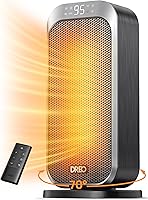
A thermostat can help control how often a heater runs, depending on the room and the setting. The DREO 1500W Thermostat Heater has a temperature sensor and ECO mode that adjusts between 1,000 W and 1,500 W.
Track electricity use if you want to understand how often a heater runs and what it draws. The Kill A Watt Meter measures appliance consumption and can forecast costs by week, month, or year.
For help understanding the circuit load, read how many amps a space heater uses.
Should you repair or replace an old space heater?
Replace an old heater if it has damage, recurring faults, or a safety feature that no longer works. For a minor issue, check the manual or ask the manufacturer whether an approved repair is available.
Compare the cost and effort of an approved repair with the condition of the whole heater. Don’t keep using a unit with a damaged cord, plug, or housing while you wait for parts.
Age alone doesn’t tell you whether a heater is safe to keep. If you can’t confirm that a fault is resolved, stop using the unit and choose a replacement that suits the room and your electrical setup.
How long do space heaters last, and when should you replace one?
For how long space heaters last, use about 10 years as a rough estimate, then consider the unit’s condition and history. Keep using a heater only when its parts and safety features work as intended.
Replace it if you find damage, recurring faults, or signs of overheating. For care, follow the manual and clean your space heater before storage.
Frequently asked questions
How long do space heaters usually last?
Many space heaters last about 10 years, but that’s a rough guide, not a promise. Use the heater’s condition, care history, and manual to judge it.
Replace it sooner if its cord, plug, controls, housing, or safety features show damage or it develops recurring faults.
Should I replace a space heater after 10 years?
Not automatically. Check the manual and the heater’s condition, and stop using it if you see a damaged cord or plug, burning smell, unusual noises, or signs of overheating.
An older heater with recurring problems may be better replaced than kept in service.
Do oil-filled space heaters last longer than ceramic heaters?
There isn’t a dependable lifespan rule based only on heater type. An oil-filled model has a sealed oil reservoir, while ceramic models use a heating element and fan.
Care, storage, use, and the condition of each heater matter more than assuming one type always lasts longer.
Can cleaning make a space heater last longer?
Cleaning can help prevent dust from blocking vents or collecting around the heater, but it can’t repair worn or damaged parts. Unplug the heater and follow its manual for cleaning.
Don’t open the unit or use it again if the cord, plug, housing, or controls are damaged.