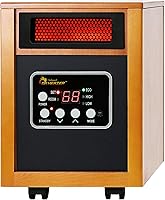
9 Best Wall-Mounted Space Heaters for a Cabin (November 2026)
The best wall-mounted space heaters for cabins include the Envi Plug-in Electric Panel Wall Heaters for quiet overnight cabin warmth, the DREO Smart Wall Heater for fast heat in a larger cabin room, and the Brightown Smart Wall Heater for dialing in an exact cabin temperature.
On this page (8 sections)
- The best wall mounted space heaters for cabins compared
- How we compared these cabin wall heaters
- What size heater does your cabin room need?
- Can cabin wiring handle a wall heater?
- Where should you mount a heater in a cabin?
- Do wall heaters dry out cabin air?
- How long will a cabin wall heater last?
- The verdict on cabin wall heaters
The best wall mounted space heater for cabin use is the Envi Plug-in Electric Panel Wall Heater, a 500W fanless panel that stays silent all night and screws to the wall in minutes. It is the top pick because cabin rooms are small and quiet, and this heater adds warmth without a fan, a contractor or a big breaker load.
Pick the DREO Smart Wall Heater when you need fast forced-air heat in a larger cabin room.
Cabins bring their own problems: thin walls, older wiring, rooms that sit unused for weeks, and a need for heat that does not sound like a jet engine at bedtime. A wall-mounted heater solves the floor-space issue.
The right one also keeps its power draw modest so it does not trip a breaker in a 1950s cabin.
This guide covers 9 heaters sold today. It compares the watts each one draws, the area it covers, how it heats (fan, convection or radiant), its safety features and how it mounts.
It also covers the practical side: sizing, circuits, mounting and keeping the unit clean.
For a cold basement room rather than a main cabin room, our space heater for basement guide covers that job. If you are still setting up heat in a lower room, the walkthrough on how to heat a basement is a useful next read.
Our picks at a glance
-
1
 Best for quiet overnight cabin warmth
Envi Plug-in Electric Panel Wall Heaters
9.7/10 our score
See it on Amazon -
2

-
3

- 4
 Check it
AMBIORA Wall Heater for Indoor Use
Best for a bathroom or damp cabin corner - 5
 Check it
EconoHome Convection Wall Heater with Thermostat
Best for a low-power off-grid cabin - 6
 Best for wide cabin rooms with a remoteCheck it
- 7
 Best for wall or floor flexibility in a small cabinCheck it
- 8
 Best for tight cabin walls and bathroomsCheck it
- 9
 Best for long quiet evenings in a big cabin roomCheck it
The best wall mounted space heaters for cabins compared
The Envi wins for most cabins because it pairs silent fanless warmth with the lowest electrical demand in this group. The rest earn their place on specific needs: speed, exact temperature control, bathroom safety or off-grid power budgets.
Our score weighs specs, features and how well each unit fits a cabin buyer's needs.
Envi Plug-in Electric Panel Wall Heaters: Best for quiet overnight cabin warmth
- 500W fanless convection panel
- Wall-sense safety sensor
- Runs 24/7
- 2-inch thick cabinet
- 3-year warranty
A silent panel that heats a small cabin room without blowing dust or drying the air, and it mounts in minutes with a screwdriver.
Pros
- No fan, so no noise overnight
- Wall-sense sensor cuts power if it leaves the mount
- Low 4.17 A draw leaves breaker room for more heaters
Cons
- Only 500W, so it suits small rooms
- Radiant warmth builds slowly rather than blasting heat
The Envi suits a cabin bedroom, bunk room or living area where people sleep close to the heater. Its patented fan-less Stack Convection design pulls cold air in at the base and lets warmed air rise, so there is no fan noise and no dust blown around.
It is only 2 inches deep, so it fits a narrow wall strip between windows. The wall-sense safety sensor cuts power if the unit is knocked off its proprietary mount, which matters in a cabin where kids and pets share the space.
Power use is the big story for cabin wiring. At 500W and 4.17 A, several Envi panels can run on one breaker, and it suits generator or solar setups.
That low draw is also its trade-off: 150 sq ft is a smaller room than the 200 to 250 sq ft most 1500W units here cover. The Envi backs it with a 3-year warranty and makes it in the USA.
DREO Smart Wall Heater: Best for fast heat in a larger cabin room
- 1500W PTC ceramic heat
- 60, 90 or 120 degree oscillation
- Alexa and Google Home control
- ALCI safety plug
- Thermostat from 41 to 95 F
A 1500W ceramic heater with wide oscillation that pushes warm air across a big cabin room fast, and takes voice or app commands.
Pros
- Fast warm-up from PTC ceramic
- Oscillation spreads heat across wide rooms
- ALCI plug and overheat protection
Cons
- 12.5 A draw needs a dedicated circuit
- Fan noise is part of the forced-air design
DREO suits a cabin great room or open living space where you want heat to arrive quickly after you walk in from the cold. Its PTC ceramic element and horizontal impeller push warm air out fast, and the head oscillates across 60, 90 or 120 degrees to reach more of the room.
That is the opposite approach to the Envi. You get speed and spread, but the fan is audible and the airflow can feel drying.
The ALCI anti-leakage plug and overheat protection are the safety story, and a self-correcting air outlet guards against malfunctions.
Controls are where this unit earns its score. Set a temperature from 41 to 95 F in the DREO app, schedule warm-up before you arrive, or use Alexa and Google Home.
A 24-hour timer and dimming display help at night.
It draws 12.5 A, so give it a dedicated circuit. The power cord recess keeps cables tidy.
If your cabin breaker panel cannot spare 12.5 A, choose a 500W panel instead.
Brightown Smart Wall Heater: Best for dialing in an exact cabin temperature
- 1500W PTC ceramic
- Thermostat from 40 to 99 F in 1 F steps
- Five modes including ECO and fan only
- Touch, remote, app and Alexa control
- ETL listed
A smart forced-air heater with 1 F thermostat steps and five modes, so you can set an exact temperature and let ECO trim the power.
Pros
- Temperature set in 1 F steps
- Five heating and fan modes
- Child lock and overheat protection
Cons
- Forced air can feel drying in a tight cabin
- Same 12.5 A circuit demand as other 1500W models
Brightown suits a cabin owner who wants to set a number and forget it. The thermostat holds within 1 F across a 40 to 99 F range, which is finer control than most heaters here offer.
Five modes include ECO plus three fixed power levels and a fan-only setting.
ECO mode adjusts output once the room hits your set temperature, which helps on a long cabin weekend. The PTC ceramic element heats fast, and the unit is ETL listed with V-0 flame-retardant materials and overheat protection.
Control comes four ways: touch panel, remote, app or Alexa. That is handy in a cabin where the heater sits high on a wall out of easy reach.
A child lock adds peace of mind.
The trade-offs are the forced-air feel and the same 12.5 A draw as other 1500W units. Brightown also advises against sharing its circuit with other high-power appliances.
The manufacturer gives a 1-year warranty.
AMBIORA Wall Heater for Indoor Use: Best for a bathroom or damp cabin corner
- 1500W PTC ceramic
- Wall, hook or desktop placement
- IPX2 water resistance
- Runs under 35 dB
- 12-hour auto-off timer
A light 3.1 lb heater you can hang on a hook, mount on the wall or stand on a desk, with splash resistance for cabin bathrooms.
Pros
- Three placement options
- IPX2 rating suits bathroom use
- Quiet operation under 35 dB
Cons
- Small body limits how much air it moves
- ECO mode allows a 5 to 6 F swing before restarting
AMBIORA suits a cabin bathroom, entryway or damp corner where a fixed wall unit feels like too much. Its IPX2 water resistance makes it safe near a shower or sink, and the 3.1 lb body is light enough to lift off a hook and carry to another room.
Three placement options set it apart: wall mount, built-in hook or desktop. That means you can hang it on a towel rack in the bathroom without drilling.
The PTC element warms air in about 3 seconds and it runs under 35 dB, quiet enough for a bedroom.
ECO mode saves energy by adjusting power to the ambient temperature. Be aware that ECO lets the room cool about 5 to 6 F below your set point before restarting, so it is looser than Brightown's control.
Use High or Low mode when you want a tighter hold.
Its small body covers up to 200 sq ft, but it moves less air than the bigger forced-air units. It covers a bathroom or bunk nook well; a full cabin great room is a stretch.
EconoHome Convection Wall Heater with Thermostat: Best for a low-power off-grid cabin
- 250W convection panel
- Runs on 2.08 A at 120V
- IP44 splash proof
- Paintable slim panel
- 3-year manufacturer warranty
A 250W panel that sips power, so it runs on a generator or solar setup without tripping a breaker, and it stays quiet with no fan.
Pros
- Lowest power draw in this group
- No fan and no dust circulation
- Slim paintable panel blends into cabin walls
Cons
- Tiny 100 sq ft coverage
- Exterior casing gets warm to the touch
EconoHome suits an off-grid or generator-powered cabin where every amp counts. It draws just 2.08 A at 250W, so it runs on solar or a small generator without straining the supply.
That is a fraction of the 12.5 A the 1500W units here pull.
The trade-off is coverage: 100 sq ft is the smallest area in this group. It works for a small cabin bathroom, a bunk nook or a closet-sized mudroom, not a whole living space.
Plan to use several if you want to warm more than one small room.
It heats by convection and some radiant warmth with no fan, so it stays quiet and does not dry the air. The exterior casing gets warm to the touch, so keep it above adult reach and clear of curtains.
The 24 x 18 x 0.40 in panel is slim and paintable, so it blends into a cabin wall. It is IP44 splash proof and cETL approved.
EconoHome gives a 3-year manufacturer warranty. The 41 to 86 F thermostat suits mild shoulder seasons more than deep winter.
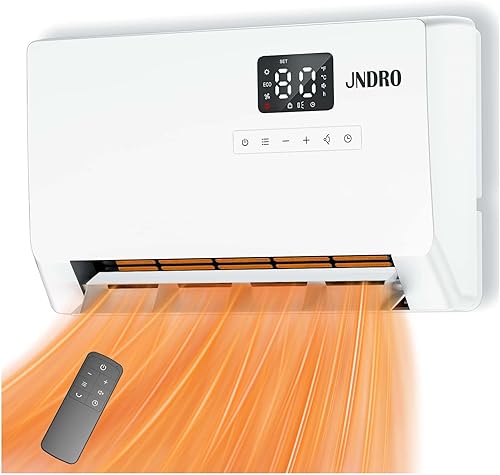
JNDRO Wall-Mounted Heater: Best for wide cabin rooms with a remote
- 1500W radiant heat
- 60, 90 or 120 degree oscillation
- Remote and LED display
- 24-hour timer
- Child lock
A remote-controlled 1500W heater with three oscillation angles, useful when you want to aim warmth across a long cabin great room.
Pros
- Three oscillation angles
- Remote control and clear LED display
- Child lock for cabins with kids
Cons
- Remote needs 2 AAA batteries not included
- Radiant heat can feel uneven close up
JNDRO suits a long cabin great room where you want to aim heat toward the seating area. Its head oscillates across 60, 90 or 120 degrees, so warm air sweeps a wide arc rather than a single spot.
The remote and LED display make it easy to adjust from the couch.
The 24-hour timer is useful in a cabin: set it to warm the room before you arrive, then let it shut off after bedtime. A child lock keeps small hands from changing settings.
At 1500W, it covers up to 200 sq ft.
It heats by radiant warmth rather than a fan blast. That feels gentler close up, but it can leave corners cooler than a forced-air unit would.
Think of it as a heater for the people in the room rather than the whole space.
The remote takes 2 AAA batteries that are not included, so bring a pair. It also draws 12.5 A and needs a dedicated circuit.
The return and replacement policy runs 12 months.
GiveBest Remote Wall Heater: Best for wall or floor flexibility in a small cabin
- 1500W forced air
- 120 degree oscillation
- Wall mount or floor stand
- Alexa app and remote control
- ETL certified
A 1500W smart heater that works on the wall or on a floor stand, handy when a cabin room changes use from season to season.
Pros
- Wall mount or floor stand
- Voice and app control
- Wide 120 degree oscillation
Cons
- 7.3 lb unit is heavier to move than small panels
- Floor stand takes up the space a wall mount saves
GiveBest Remote suits a cabin room that changes use through the year. In winter it might be a guest bedroom; in summer it might be a sunroom.
This heater mounts on the wall or sits on a floor stand, so you can move it without buying a second unit.
The 120 degree oscillation and fast heat suit open cabin layouts. ECO mode adjusts power to the room's temperature to trim energy use.
You can run it by touch panel, remote, app or Alexa.
At 7.3 lb it is heavier than the small panels here, so moving it between rooms takes some effort. The floor stand also takes up the floor space that a wall mount is meant to save.
If you mostly want a fixed wall unit, the Envi or DREO are better picks.
It is ETL certified with flame-retardant and overheat protection, plus a child lock. The 1500W element covers about 200 sq ft.
For a cabin bathroom or damp spot, choose the AMBIORA instead.
GiveBest Slim Wall Heater: Best for tight cabin walls and bathrooms
- 1500W PTC ceramic
- Slim cabinet under 5 in deep
- Wall template for mounting
- ALCI plug and IP24 water resistance
- Child lock
A compact 6.1 lb heater that fits narrow wall strips and handles bathroom humidity with an IP24 rating and ALCI plug.
Pros
- Slim depth saves wall space
- IP24 rating for bathroom use
- Simple template-guided mounting
Cons
- Six heating modes to learn
- Needs a dedicated circuit at 12.5 A
GiveBest Slim suits a cabin with narrow wall strips where a big heater will not fit. Its slim cabinet is under 5 in deep, so it tucks into a tight space between a window and a door.
The mounting template makes installation straightforward.
It handles humidity better than most units here. An IP24 water-resistance rating and an ALCI safety plug make it a candidate for a cabin bathroom.
Child lock and overheat protection round out the safety features.
The 1500W PTC element covers up to 200 sq ft, and the five modes run from high heat to fan only. The 1 F thermostat accuracy helps hold a set temperature.
You can also control it by remote or app once connected to WiFi.
The trade-off against the AMBIORA is flexibility: the AMBIORA hangs on a hook or sits on a desk, while this one is a fixed wall unit. Its 12.5 A draw needs a dedicated circuit.
It is a solid bathroom pick for cabins with modern wiring.
Ballu Mica Panel Heater: Best for long quiet evenings in a big cabin room
- 1500W mica far-infrared
- Wall mount or caster stand
- WiFi app and Alexa control
- 24-hour timer
- 2-year warranty
A wide 27-inch mica panel that radiates gentle warmth over a bigger cabin room, with a caster option for moving it between spaces.
Pros
- Broad 250 sq ft coverage
- Quiet radiant warmth with little dryness
- Wall mount or rolling casters
Cons
- Widest cabinet in this group
- Heavier unit to move by hand
Ballu suits a large cabin room where you want even, quiet warmth over a long evening. Its mica far-infrared panels radiate gentle heat, and the all-metal design is built to last.
The wide 27-inch cabinet covers up to 250 sq ft, the most area in this group.
That size is also its drawback: the cabinet is the widest here, so it needs a long clear stretch of wall. If your cabin walls are broken up by windows and doors, a compact unit like the GiveBest Slim fits more easily.
It heats in about 10 seconds and spreads warmth across 180 degrees. The exposed temperature sensor and adjustable thermostat help trim energy use, and Ballu says it can save up to 37 percent on energy cost.
The remote, digital panel or app controls make adjustments easy.
It can sit on rolling casters or mount on the wall. The caster option is handy for moving it between rooms, though the unit is heavier than the small panels.
Safety includes auto shut-off if tipped, overheat protection and a 24-hour timer. Ballu gives a 2-year warranty.
How we compared these cabin wall heaters
We compared these heaters by the specs that matter in a cabin: wattage and amp draw, stated coverage, heating method, safety features and mounting options. We judged them on published specs and manufacturer details, not on personal use.
The score weighs those specs against what a cabin buyer needs most: quiet operation, low electrical demand, a safe install and enough heat for the room.
We gave extra weight to how each unit behaves overnight, since cabins are places where people sleep near the heater. Fanless convection and radiant panels scored higher for bedrooms.
Forced-air units scored higher when a buyer needs fast heat in a big open room.
Electrical demand was the second factor. A cabin's wiring is often older or shared with lights and a fridge.
Units that draw 12.5 A need a dedicated circuit, and we noted that in every relevant write-up. Panels at 250W or 500W leave more room on the breaker panel.
Mounting ease and safety sensors rounded out the comparison. A unit that installs with a screwdriver and a template is easier to live with than one that needs a contractor.
A wall-sense or tip-over switch is a real safety plus in a space with kids and pets.
| Product | Best for | Heat output | Coverage | Heating method | Our score |
|---|---|---|---|---|---|
| Envi Plug-in Electric Panel Wall Heaters | quiet overnight cabin warmth | 500W | 150 sq ft | Convection | 9.7 |
| DREO Smart Wall Heater | fast heat in a larger cabin room | 1500W | 215 sq ft | Forced air | 9.6 |
| Brightown Smart Wall Heater | dialing in an exact cabin temperature | 1500W | 200 sq ft | Forced air | 8.8 |
| AMBIORA Wall Heater for Indoor Use | a bathroom or damp cabin corner | 1500W | 200 sq ft | 8.3 | |
| EconoHome Convection Wall Heater with Thermostat | a low-power off-grid cabin | 250W | 100 sq ft | Convection and radiant | 8.0 |
| JNDRO Wall-Mounted Heater | wide cabin rooms with a remote | 1500W | 200 sq ft | Radiant | 7.5 |
| GiveBest Remote Wall Heater | wall or floor flexibility in a small cabin | 1500W | 200 sq ft | 7.3 | |
| GiveBest Slim Wall Heater | tight cabin walls and bathrooms | 1500W | 200 sq ft | Forced air | 7.2 |
| Ballu Mica Panel Heater | long quiet evenings in a big cabin room | 1500W | 250 sq ft | Convection and mica far-infrared | 7.1 |
What size heater does your cabin room need?
Size the heater to the room, not the cabin's total square footage. A 1500W heater warms about 200 to 250 sq ft in a well-insulated room.
A 500W panel covers about 150 sq ft, and a 250W panel covers about 100 sq ft.
Measure the room you want to heat first. A cabin bedroom of 10 x 12 ft is 120 sq ft, which a 500W panel handles.
A 16 x 20 ft great room is 320 sq ft, so plan on a 1500W unit, possibly two.
How wattage maps to cabin room sizes
Here is the rough rule from the heaters in this group. A 250W panel like the EconoHome warms a bathroom or closet-sized room.
A 500W panel like the Envi warms a bedroom or bunk room. A 1500W unit like the DREO, Brightown or Ballu warms a living area or open cabin space.
These figures assume decent insulation. A drafty log cabin loses heat faster, so round up a size or add a second heater.
A well-sealed modern cabin can run smaller.
When to use two smaller heaters instead of one big one
Two 500W panels often beat one 1500W heater in a cabin. Each draws 4.17 A, and together they use less than a single 12.5 A unit.
They also spread warmth across two rooms instead of one.
If your cabin has separate bedrooms, a panel in each room gives better comfort than one big unit in the hall. This is where the Envi's low draw really helps.
Several can share a circuit without tripping a breaker.
Can cabin wiring handle a wall heater?
Check the breaker first. A 1500W heater pulls about 12.5 A at 120V and should sit on its own 15 or 20 A circuit.
A 500W panel pulls 4.17 A, so more than one can share a circuit. Older cabin wiring may not meet either demand safely.
Matching amp draw to your breaker panel
Look at the label on the breaker feeding the outlet you plan to use. If it is a 15 A breaker, a 12.5 A heater leaves little headroom for lights or a fridge on the same line.
A 20 A breaker handles a 1500W heater on its own.
The Envi's 4.17 A draw is the friendliest here for shared circuits. The EconoHome's 2.08 A is lower still.
If you plan to run a generator or solar inverter, both low-watt panels are the safer choice.
Generator and solar setups for off-grid cabins
For a generator, add up the running watts of everything you want on at once. The EconoHome at 250W leaves plenty of room.
The Envi at 500W lets you run a couple of panels and still power lights and a fridge.
Solar inverters have a continuous output limit too. A 1000W inverter can run one 500W panel comfortably.
It cannot run a 1500W heater. Match the heater to your inverter's rating before buying.
Where should you mount a heater in a cabin?
Mount it on a clear wall with space around the vent. Heaters need clearance for air to move, and the instructions state the exact distances.
Keep the unit off the floor and away from curtains, bedding and firewood.
Best spots for bedrooms and bunk rooms
In a bedroom or bunk room, mount the heater on the wall opposite the beds at about knee to waist height. That lets convection warmth rise through the room without blowing on sleepers.
The Envi's 2-inch depth fits a narrow strip between windows.
Avoid mounting above a bed or bunk. Falling bedding or a bumped ladder is a real risk.
A wall-sense sensor like the Envi's adds protection if the unit is knocked loose.
Bathroom and entryway placement
For a cabin bathroom, choose a unit with a water-resistance rating. The AMBIORA carries IPX2, and the GiveBest Slim carries IP24.
The EconoHome is IP44 splash proof. Keep any heater at least 12 inches from water sources, as EconoHome specifies.
Entryways suit a heater that warms fast. A 1500W forced-air unit like the DREO or Brightown brings heat quickly when the door has been open.
Mount it above the draft line, not where snow will land.
Do wall heaters dry out cabin air?
A fanless panel dries the air less than a forced-air unit. Fans move a lot of air across a hot element, which lowers relative humidity and can stir up dust.
Convection and radiant panels warm the air more gently and keep humidity steadier.
Fanless versus forced-air comfort
The Envi's fanless design pulls cold air in at the base and lets warmed air rise. It does not blow dust or allergens, and it helps keep humidity in the room.
For a cabin bedroom, that means less dry throat and fewer winter nosebleeds.
Forced-air units like the DREO, Brightown and GiveBest models move warm air fast. That is great for a cold great room after a day outside.
It is less comfortable for sleeping right next to the heater all night.
Keeping dust and allergens down
Dust settles on any heater over time. A fanless panel collects less because it does not pull air through a fan.
Wipe the surfaces and vents as part of your cabin cleaning routine. Our guide on how to clean a space heater covers the steps safely.
If someone in the cabin has allergies or asthma, a fanless unit is the kinder choice. The EconoHome and Envi both heat without circulating dust.
The Ballu's mica panels also keep air movement low.
How long will a cabin wall heater last?
A well-built wall heater should last several years, and the warranty tells you what the maker will stand behind. The Envi carries a 3-year warranty and the EconoHome a 3-year manufacturer warranty.
Ballu offers 2 years, and Brightown offers 1 year.
Warranty and build quality to expect
The Envi's fanless design has no moving parts, which the maker calls 100 percent maintenance-free with zero lifetime repair costs. Fewer moving parts generally means fewer failures.
The EconoHome's triple-reinforced panel is built to resist cracking.
A forced-air unit has a fan that wears over time. That does not make it a bad buy, but expect more to go wrong than on a fanless panel.
Our guide on how long space heaters last covers the signs it is time to replace one.
Signs it is time to replace your heater
Watch for a heater that no longer reaches its old temperature, a fan that rattles, a plug or cord that feels hot, or a burning smell. Any of these means stop using it.
In a cabin that sits empty for weeks, inspect the heater before the first cold weekend.
Also check the mount each season. A loose bracket on a wall heater is a safety problem.
Tighten it or replace the hardware before running the unit.
The verdict on cabin wall heaters
The best wall mounted space heater for a cabin is the Envi Plug-in Electric Panel Wall Heater, because it runs silent, mounts in minutes and draws only 4.17 A. For a cabin bedroom or bunk room where people sleep near the heat, nothing else here matches its quiet, low-power fit.
Choose the DREO Smart Wall Heater for a large cabin great room that needs fast heat and app control. Pick the Brightown if exact temperature steps matter, and the AMBIORA for a bathroom or a heater you can move from room to room.
For an off-grid cabin on solar or a generator, the EconoHome's 250W draw is the safe pick for a small room. For a wide cabin living area, the Ballu's 250 sq ft coverage and quiet mica panels earn their space.
Pick the Envi for most cabins, and size up to a 1500W unit only when the room and the wiring allow it.
Our top 3 picks at a glance
-
1
Best for quiet overnight cabin warmth
Envi Plug-in Electric Panel Wall Heaters
9.7/10 our score
See it on Amazon -
2
-
3
Frequently asked questions
What wattage do I need for a cabin space heater?
A 1500W heater warms roughly 200 to 250 sq ft in a well-insulated room. For a small cabin bedroom or bunk room of 150 sq ft or less, a 500W panel like the Envi keeps the load light.
Check the cabin's insulation and how cold it gets before sizing up.
Can a wall heater run on a generator or solar setup?
Yes, if the heater's draw fits what the system supplies. A 500W panel pulls about 4.17 A, so several can share a circuit.
A 1500W heater pulls 12.5 A and needs more capacity from the generator or inverter.
Are wall-mounted heaters safe to leave on overnight?
Panels with overheat protection and a tip or wall sensor are designed for long runs. The Envi can run 24/7 and has a wall-sense switch that cuts power if the unit leaves its mount.
Still keep bedding and curtains clear of the vent.
How do I mount a space heater on a cabin wall?
Most units come with a bracket and template. Mark the holes, drill, fix the bracket to studs or anchors rated for the weight, then hang the heater.
The Envi mounts with just a screwdriver.
Leave the clearance around the vent the instructions call for.
Do wall heaters need a dedicated electrical circuit?
A 1500W heater pulls 12.5 A and should sit on its own circuit. Lower-watt panels are more forgiving.
The Envi draws 4.17 A at 500W, so more than one can run on a single breaker, which matters in cabins with older wiring.