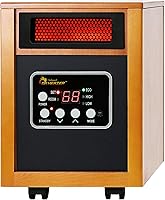
9 Best Portable Electric Space Heaters (November 2026)
The best portable electric space heaters include the GiveBest Space Heater (best overall), the Amazon Basics Ceramic Space Heater for a home office, and the Gaiatop Mini Space Heater for a desk.
On this page (9 sections)
- The best portable electric space heaters for each room
- How these portable electric space heaters compare
- How we compared these heaters
- What size heater do you need for your room?
- What safety features should you check before buying?
- How much does it cost to run a portable electric space heater?
- Ceramic, infrared or fan: which heater type fits your room?
- Where should you place a portable space heater?
- Which portable electric space heater should you buy?
The best portable electric space heater for most people is the GiveBest Space Heater, which heats up to 200 sq ft with 1500W and 750W modes and a cool-air fan. Pick the Dr Infrared DR-968 if you need to warm a large room, or the Gaiatop Mini if you only need warmth at a desk.
Room size decides almost everything here. A heater rated for 200 sq ft will struggle in an open living room, and a 576 sq ft cabinet heater is overkill beside a desk.
Match the coverage number to the room you want warm.
Every pick below runs on a standard 120V outlet. Most full-size models draw 12.5 amps at 1500W, so plan on one heater per circuit.
Mini heaters at 500W are easier to place near your chair.
Our score weighs specs, features and buyer feedback against what you're shopping for. We compared heat coverage, safety shut-offs, noise ratings and controls.
Our picks at a glance
-
1

-
2

-
3

- 4
 Best tower for bedroomsCheck it
- 5
 Check it
Amazon Basics Ceramic Space Heater
Best for small desks - 6
 Best for large roomsCheck it
- 7
 Best for quiet bedroomsCheck it
- 8
 Best for large bedroomsCheck it
- 9
 Check it
JIBUFI Portable Space Heater for Indoor Use
Best for moving room to room
The best portable electric space heaters for each room
The GiveBest is the strongest all-round pick for a bedroom or office, while the other models here win on coverage, quiet running or desk-level warmth. Choose by the room you need to heat before comparing extra features.
GiveBest Space Heater: Best overall
- 1500W and 750W heating plus fan-only mode
- Heats up to 200 sq ft
- Tip-over and overheat shut-off
- Quiet ceramic PTC element
A small ceramic heater with two heat levels, a thermostat and a cool-air fan. It covers most bedrooms and offices without taking up much floor or desk space.
Pros
- Two heat settings plus fan-only
- Automatic thermostat cycling
- Tip-over and overheat protection
Cons
- Heats one small to medium room, not a whole house
- Two-prong cord
GiveBest suits a bedroom, office or small living room up to 200 sq ft. Its two heat levels plus a cool fan cover winter warming and summer air movement in one body that measures 6.2 x 7.9 x 10.2 inches.
The automatic thermostat cycles the element on and off to hold your set temperature. A tip-over shut-off cuts power with a beep if the unit gets knocked over, and it restarts when set upright again.
The ceramic PTC element heats quickly and GiveBest rates the noise below normal conversation. That makes it workable beside a bed, though any fan-forced heater has some sound.
It weighs 3 lb and has a built-in carry handle, so moving it between rooms is simple. The 6 ft cord reaches most outlets without an extension lead.
Buy it for a small to medium room you heat daily. Skip it if your space is closer to 400 sq ft, where a cabinet heater fits better.
See our space heater for basement picks if your room is below grade.
Amazon Basics Ceramic Space Heater: Best for a home office
- High 1500W, low 900W and fan-only modes
- Tip-over and overheat protection
- 43 dB noise level
- Weighs 2.8 lb
Three settings and a thermostat in a 3 lb cabinet. The 43 dB rating makes it a sensible pick for a desk or a small office.
Pros
- Three modes including fan-only
- Compact 2.8 lb body
- Tip-over and overheat shut-off
Cons
- Not for bathrooms or damp rooms
- No oscillation
Amazon Basics makes the simplest pick for a home office. Its three settings are high at 1500W, low at 900W and fan-only for air without heat.
The cabinet weighs 2.8 lb and stands 9.45 inches tall.
Amazon Basics rates it at 43 dB, quiet enough for focused work. Tip-over protection, overheat protection and a power light cover the safety side.
The thermostat adjusts to your target warmth rather than a fixed output. One trade-off: Amazon Basics says to keep it out of bathrooms and laundry rooms, so it is not the pick for a damp space.
It does not oscillate, so the warm air stays in one direction. Aim it at your chair and let the thermostat do the rest.
That is fine for a desk, less so for spreading heat across a wide room.
Buy it for a home office or small study. Skip it for a bathroom or a big open room.
Our how to clean a space heater guide keeps the intake clear through the season.
Gaiatop Mini Space Heater: Best for a desk
- 500W PTC ceramic element
- Warms in about 2 seconds
- 45 degree tip-over protection
- Quiet operation
A 500W mini heater for a desk, dorm or apartment corner. It uses far less power than a 1500W unit, so it warms you rather than a whole room.
Pros
- Very small footprint
- Low 500W draw
- Fast PTC warm-up
Cons
- 500W suits personal warmth only
- No thermostat described
Gaiatop is the pick for a desk, dorm or apartment corner where you want warmth on you rather than the whole room. The 500W PTC element heats in about 2 seconds, and the body is small enough to sit beside a monitor.
Because it draws 500W, it is gentler on a shared circuit than a 1500W unit. That matters in a dorm or a home office where other devices share the outlet.
Safety covers 45 degree tip-over protection, overheat protection and V0 fireproof material. An LED light shows when it is running.
Gaiatop describes the operation as quiet and energy saving.
The 500W output is the real limit: it warms your hands and face, not a 200 sq ft room. Plan on it as a personal heater for one seat.
Buy it for close-range warmth at a desk. Skip it if you want to raise the temperature of a whole room.
The Amazon Basics ceramic is the better office pick for room-level heat.
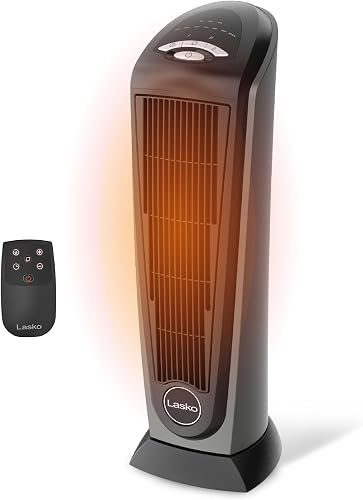
Lasko 751320 Ceramic Tower: Best tower for bedrooms
- 1500W ceramic heat with wide oscillation
- Remote control and 7-hour timer
- Overheat protection
- Cool-touch housing
A 23 in tower that spreads heat across a bedroom with oscillation. The remote and timer let you change settings from bed.
Pros
- Oscillation spreads heat
- Remote control and 7-hour timer
- Carry handle for room changes
Cons
- Rated for about 150 sq ft
- Taller than a desk heater
Lasko suits a bedroom where you want heat spread across the room from one spot. The 22.5 inch tower oscillates widely, so warm air reaches past the foot of the bed instead of one patch of floor.
The remote control handles heat settings, oscillation and a 7-hour timer without leaving the couch or bed. Set the timer and the heater shuts itself down while you sleep.
Lasko rates coverage at about 150 sq ft and lists a thermostat range of 60 to 85 F. A self-regulating ceramic element, overheat protection and cool-touch housing keep the cabinet safe to touch near kids and pets.
It weighs 2.5 lb with a carry handle, so moving it to the living room in the evening is easy. The trade-off against the GiveBest is coverage: 150 sq ft against 200.
Buy it for a bedroom or living room with a seating area. Skip it for a large open space.
This is also a good electric space heater for sunroom use if the glass room stays small.
Amazon Basics Ceramic Space Heater: Best for small desks
- 500W ceramic heating
- Weighs 1.4 lb
- Tip-over protection
- 48 dB operation
The lightest heater here at 1.4 lb. Its 500W element and small white body fit on a tabletop without crowding your work.
Pros
- Lightest pick in this roundup
- Small tabletop footprint
- Tip-over shut-off
Cons
- One speed only
- 500W limits it to spot warmth
The second Amazon Basics model is the lightest heater here at 1.4 lb. Its white rectangular body measures 5.87 x 3.2 x 6 inches, so it takes up very little desk or tabletop space.
Amazon Basics rates it for about 107.6 sq ft and describes fast 500W ceramic heating in seconds. At 48 dB it is slightly louder than the 1500W Amazon Basics unit.
Tip-over protection shuts it off if it gets knocked over, which matters on a crowded desk. It has one speed only, so you cannot dial the output down.
This is the pick when portability matters more than room coverage. Carry it from the kitchen table to the desk as you move around the house.
Buy it for a desk or tabletop spot. Skip it if you need to warm a room bigger than about 100 sq ft.
The Lasko tower covers more space for a similar footprint on the floor.
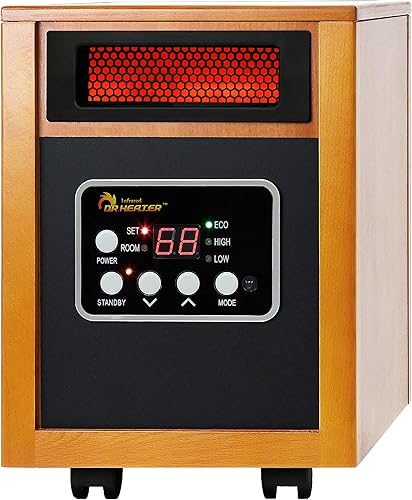
Dr Infrared DR-968 Heater: Best for large rooms
- Infrared quartz plus PTC dual heating
- Heats up to 576 sq ft
- Remote and 12-hour timer
- Caster wheels and lifetime filter
A cabinet-style heater rated for 576 sq ft, the largest coverage here. Wheels and a remote make it easier to move and control in a big room.
Pros
- Largest stated coverage
- Caster wheels for moving
- 12-hour automatic shut-off timer
Cons
- 19 lb and bulky
- Quietest in name only at 39 dB
Dr Infrared is the large-room pick. Its dual heating system pairs an infrared quartz tube with a PTC element, and Dr Infrared rates coverage at 576 sq ft, more than double the GiveBest.
It is a 19 lb cabinet on caster wheels, so you roll it where you need it instead of carrying it. The remote control and 12-hour automatic shut-off timer suit a living room or open plan space.
The electronic thermostat runs from 50 to 85 F. Dr Infrared rates the blower at 39 dB and includes a lifetime filter, which helps keep dust out of the element.
This is not a desk or bedroom heater. It is large, heavy and built to warm a wide area from one corner.
That makes it the choice for a big living room or a finished garage.
Buy it for a large room or open plan space. Skip it for a bedroom or office where a 3 lb heater does the job.
Our guide to how long do space heaters last covers keeping the filter and element clean.
DREO 1500W Thermostat Heater: Best for quiet bedrooms
- 1500W PTC ceramic heat
- 34 dB quiet operation
- 70 degree oscillation
- 12-hour timer and ECO mode
A 270 sq ft tower that runs at 34 dB and oscillates 70 degrees. ECO mode trims the draw to 1000W when the room is warm enough.
Pros
- Very quiet 34 dB rating
- ECO mode saves energy
- 270 sq ft coverage
Cons
- Must plug straight into a wall outlet
- Tower footprint takes floor space
DREO's 1500W tower targets quiet bedrooms. It runs at 34 dB, which DREO compares to a library, and its 70 degree oscillation spreads heat across up to 270 sq ft.
ECO mode uses a temperature sensor to switch between 1000W and 1500W, so it holds your set warmth without running flat out. The 12-hour timer and remote handle evening changes from bed.
Safety covers tip-over protection, overheat protection, a 24-hour automatic power-off and V0 flame-retardant materials. DREO says to plug it straight into a wall outlet and not an extension cord.
Against the GiveBest it wins on coverage and quiet running but takes more floor space as a tower. The 270 sq ft rating also beats the Lasko's 150.
Buy it for a bedroom or living room up to 270 sq ft. Skip it if you only need desk-level warmth.
This is a strong choice when quiet matters more than a small footprint.
DREO 25 Inch Tower Heater: Best for large bedrooms
- 25 in tower with 11.5 ft/s airflow
- 25 dB operation
- Child lock and tip-over protection
- Thermostat from 41 to 95 F
A 25 in tower with four modes, 70 degree oscillation and 1 degree thermostat steps. The child lock and 25 dB rating suit a family bedroom.
Pros
- Quiet 25 dB rating
- Child lock setting
- Precise 1 degree thermostat
Cons
- Taller body needs floor space
- Higher 16 A draw
DREO's 25 inch tower is the family-bedroom pick. The taller body pushes air at 11.5 ft/s and runs as low as 25 dB, the quietest rating in this roundup.
A child lock setting reduces the risk of accidental changes, and tip-over and overheat protection are ETL certified. The thermostat adjusts in 1 degree steps from 41 to 95 F.
Four modes (H1, H2, H3 and ECO) plus a fan-only setting cover different needs, and 70 degree oscillation reaches 100 to 270 sq ft. It weighs 7.3 lb, so it stays put once placed.
The trade-offs are size and power: a 25 inch tower needs floor space, and its 16 A draw is higher than the 12.5 A units here. Check your circuit before adding it to a busy room.
Buy it for a large bedroom with kids or pets. Skip it for a small office.
The lower, lighter GiveBest fits a tight room better.
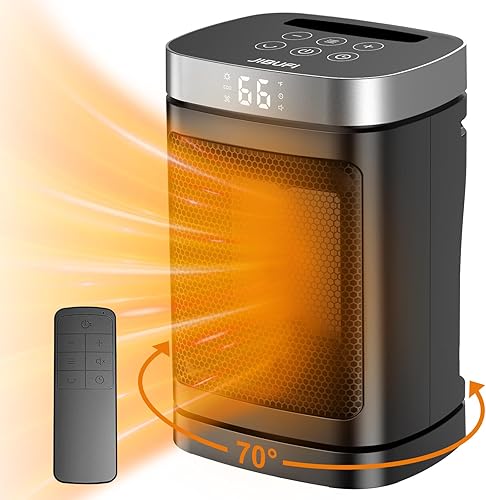
JIBUFI Portable Space Heater for Indoor Use: Best for moving room to room
- 1500W heat for up to 200 sq ft
- 70 degree oscillation
- Remote control and 12-hour timer
- ECO mode and five settings
A small 1500W heater with a remote and five modes. Its compact body moves easily between rooms, and ECO mode adjusts the warmth for you.
Pros
- Remote control included
- Five modes plus fan-only
- Light enough to carry around
Cons
- Rated for 200 sq ft
- Remote needs two AAA batteries
JIBUFI suits someone who heats a different room each evening. Its compact body is light enough to carry, and the remote control and five modes make it easy to switch between high, medium, low, ECO and fan-only.
It delivers 1500W for up to 200 sq ft and oscillates 70 degrees to spread the warmth. ECO mode sets its own temperature to save energy, and a 12-hour timer handles shut-off.
Safety covers ETL certification, tip-over protection, overheat protection and an enhanced safety plug with flame-retardant materials. It runs quietly enough for sleep or work.
The remote needs two AAA batteries that are not included, so pick those up. Against the GiveBest it adds a remote and a timer but carries a lower overall score for its smaller stated coverage.
Buy it for a room-to-room routine with a remote. Skip it if you want one fixed heater for a large space.
The Dr Infrared covers far more area.
How these portable electric space heaters compare
The table lines up heat output, stated coverage and form so you can see the trade-offs in one place. Coverage numbers come from each brand and describe the area a heater is meant to warm, not a guarantee in every room.
| Product | Best for | Heat output | Coverage | Weight | Our score |
|---|---|---|---|---|---|
| GiveBest Space Heater | overall | 1500 W | 200 sq ft | 3 lb | 9.7 |
| Amazon Basics Ceramic Space Heater | a home office | 1500 W | 2.8 lb | 9.6 | |
| Gaiatop Mini Space Heater | a desk | 500 W | 9.5 | ||
| Lasko 751320 Ceramic Tower | tower for bedrooms | 1500 W | 150 sq ft | 9.1 | |
| Amazon Basics Ceramic Space Heater | small desks | 500 W | 107.6 sq ft | 1.4 lb | 9.1 |
| Dr Infrared DR-968 Heater | large rooms | 1500 W | 576 sq ft | 19 lb | 8.9 |
| DREO 1500W Thermostat Heater | quiet bedrooms | 1500 W | 270 sq ft | 8.8 | |
| DREO 25 Inch Tower Heater | large bedrooms | 1500 W | 100 to 270 sq ft | 8.5 | |
| JIBUFI Portable Space Heater for Indoor Use | moving room to room | 1500 W | 200 sq ft | 8.2 |
How we compared these heaters
We started with the room each heater is meant to warm. Coverage ranged from about 107 sq ft for the mini Amazon Basics unit to 576 sq ft for the Dr Infrared cabinet.
Next we checked the safety features. Every pick here has tip-over and overheat protection, and most list V0 flame-retardant materials.
The DREO 25 inch tower adds a child lock.
We looked at the controls next: thermostat type, timers, remotes and modes. A 7-hour timer and a remote matter more in a bedroom than at a desk.
Finally we weighed noise ratings and form. A 25 dB tower and a 500W desk heater solve different problems, so the score reflects how well each one fits the room it targets.
What size heater do you need for your room?
Match the heater's coverage rating to the room's square footage, then round up slightly for a poorly insulated space. A 200 sq ft bedroom suits the GiveBest; a 400 sq ft living room needs the Dr Infrared.
Measure the room's length by its width to get square footage. A 12 x 16 ft bedroom is 192 sq ft, close to the GiveBest's 200 sq ft rating.
A 20 x 20 ft living room is 400 sq ft and needs a cabinet heater.
Heaters for small rooms and bedrooms
A 1500W ceramic heater rated for 150 to 270 sq ft covers most bedrooms. The GiveBest, Lasko and DREO 1500W models all fit this range.
Choose a mini 500W heater only for a desk or a spot beside your chair.
Heaters for large rooms and open spaces
Look for 400 sq ft and up. The Dr Infrared DR-968 is rated for 576 sq ft and rolls on casters.
In an open plan space, close interior doors so the heat stays in the room you are using.
What safety features should you check before buying?
Look for tip-over protection, overheat shut-off and a flame-retardant body, and plug the heater straight into a wall outlet. Every heater in this roundup has tip-over and overheat protection, so the difference comes down to extras like a child lock.
Tip-over protection cuts power when the unit falls or gets knocked. Overheat protection cuts power when the element gets too hot.
Together they cover the two most common accidents.
A thermostat also helps safety by stopping the element from running past your set temperature. DREO's 24-hour automatic power-off adds another layer for forgetful evenings.
Keep the heater on a hard, level surface and clear of bedding, curtains and paper. Leave at least 3 feet of space around it and never run it under a desk where a blanket could fall onto it.
Do you need a heater with a thermostat?
Yes, if you plan to leave it running for hours. A thermostat cycles the element on and off to hold a set temperature, so the room does not overheat and the heater uses less power.
Every full-size pick here except the mini heaters has one.
Are space heaters safe on carpet?
Yes, when they stand on a hard, flat base and the intake and vents stay clear. Cabinet heaters like the Dr Infrared sit on casters above the pile.
Avoid setting a mini heater directly into deep carpet where the base can sink and block airflow.
How much does it cost to run a portable electric space heater?
A 1500W heater uses about 1.5 kWh per hour at full output. A 500W desk heater uses about 0.5 kWh per hour.
Run your local electricity rate against those figures to estimate an hourly cost.
The thermostat matters more than the wattage for your bill. A heater that cycles off when the room reaches temperature runs fewer full-power minutes than one left on high.
DREO's ECO mode drops to 1000W when the room is warm enough.
Heating one room instead of the whole house is the real saving. Close the door, heat the room you sit in and let the central system rest.
Does a higher wattage always mean more heat?
No. A 1500W heater and a 500W heater both make heat; the 1500W unit moves more warm air and covers more space.
A 500W mini heater warms the person in front of it faster than it warms a room.
Do space heaters raise the electric bill a lot?
They can if you run one all day at full power. Used with a thermostat in one room for a few hours, a 1500W heater adds a modest amount.
Compare the hourly draw with your rate before deciding how long to run it.
Ceramic, infrared or fan: which heater type fits your room?
Ceramic heaters warm the air and blow it around a room. Infrared heaters warm people and objects in their path.
Fan-only mode just moves air without adding heat.
Pick ceramic for a whole small room and infrared for a spot.
Ceramic PTC elements heat quickly and hold their output. Most picks here are ceramic, including the GiveBest, the Amazon Basics models and both DREO towers.
They suit bedrooms and offices where you want the room warmer.
Infrared quartz warms surfaces directly, so you feel it sooner when you sit in front of it. The Dr Infrared DR-968 pairs infrared with a PTC element and a blower to combine both approaches in a large room.
Fan-only settings are useful in summer for air movement. Several picks here include one, including the GiveBest and the Amazon Basics ceramic.
Is a ceramic heater better than a fan heater?
Ceramic heats the air as it passes the element, so the air leaving the unit is warmer than a plain fan heater. That makes ceramic better for raising room temperature.
Fan-only mode is only for moving air.
Is infrared heating cheaper to run?
Not by wattage. A 1500W infrared heater draws the same power as a 1500W ceramic one.
Infrared can feel warmer sooner because it heats you directly, so you may run it for shorter stretches.
Where should you place a portable space heater?
Put the heater on a hard, level floor in the room you want warm, at least 3 feet from curtains, bedding and furniture. Aim it toward the seating area, not a wall, and keep the intake and vents clear.
A corner placement with oscillation spreads heat further than a straight-on blast. The Lasko and DREO towers both oscillate, so a corner spot works well for them.
Do not tuck a heater under a desk or behind a couch. Blocked airflow makes the overheat protection trip or, worse, lets heat build against nearby material.
Keep it out of doorways and walkways where someone could trip over the cord. A 6 ft cord like the one on the GiveBest reaches most wall outlets without an extension.
Can you put a space heater in a bathroom?
Only a model rated for damp rooms. Amazon Basics says its ceramic heater is not for bathrooms or laundry rooms.
If you need bathroom warmth, buy a heater specifically rated for wet areas and keep it away from the tub and shower.
Should a space heater go on the floor or a table?
Follow the maker's mounting type. Tower and cabinet heaters are floor models; mini heaters like the Gaiatop and the Amazon Basics mini are tabletop units.
Setting a floor heater on a table risks a tip-over.
Which portable electric space heater should you buy?
For most rooms, buy the GiveBest Space Heater: it heats up to 200 sq ft, has two heat levels and a fan, and adds tip-over and overheat protection at 3 lb. It is the best portable electric space heater for a bedroom or office you warm every day.
Pick the Dr Infrared DR-968 if your room is closer to 500 sq ft. Choose the Gaiatop Mini or the 1.4 lb Amazon Basics for a desk.
The DREO 25 inch tower wins when quiet running and a child lock matter most.
Before you buy, measure the room and check your circuit. One 1500W heater on its own outlet is the safest setup.
Then keep the intake clean, as our how to clean a space heater guide explains, and it will keep working for years.
Our top 3 picks at a glance
-
1
-
2
-
3
Frequently asked questions
How many watts does a portable electric space heater use?
Most full-size models run at 1500W on high, which is about 12.5 amps on a standard US 120V circuit. Mini desk heaters run at 500W, so you can plug one into a shared office outlet without tripping a breaker.
Can you leave a portable space heater on overnight?
Only if it has a thermostat and an automatic shut-off, and only on a hard, clear surface. Heaters with tip-over and overheat protection cut power when something goes wrong.
Keep bedding and curtains at least 3 feet away.
Why does a space heater trip the breaker?
A 1500W heater draws 12.5 amps, and most household circuits carry 15 amps total. Add a lamp or a laptop charger and the breaker trips.
Run the heater on its own outlet and never use an extension cord.
Do ceramic space heaters dry out the air?
They warm the air without adding or removing much moisture. The dry feeling comes from heated air raising the room temperature and lowering relative humidity.
A small bowl of water nearby helps if the air feels stale.
What is the difference between a ceramic heater and an infrared heater?
A ceramic heater blows warm air around the room. An infrared heater warms people and objects in its path directly.
Ceramic suits a whole small room; infrared suits a spot where you sit or work.