9 Best Electric Space Heaters for a Sunroom (November 2026)
The best electric space heaters for sunrooms include the Amazon Basics Ceramic Space Heater (best overall), the Lasko 751320 Ceramic Tower for wide rooms, and the Dr Infrared DR-968 Heater for large glass rooms.
On this page (7 sections)
The best electric space heater for a sunroom for most people is the Amazon Basics Ceramic Space Heater, a compact 1500W unit that warms a seating corner quickly and carries tip-over and overheat protection for peace of mind. For a large glass room, the Dr.
Infrared DR-968 covers the most area; for a long narrow sunroom, the DREO 16 Inch Tower spreads heat sideways.
A sunroom is an unusual heating job. Glass loses heat faster than an insulated wall, and the space often swings from warm in the afternoon sun to cold after sunset.
A 1500W portable heater won't replace a furnace, but it can make the room usable while you're in it if you pick the right type and place it near where you sit.
This guide compares nine heaters by heat type, size, coverage, controls and safety features. Every pick gets a "Best for" badge so you can match one to your room's shape and how you use it.
Our picks at a glance
-
1

-
2
-
3
- 4
 Best for desk cornersCheck it
- 5
 Check it
VOCRS Small Portable Space Heater for Indoor
Best for tight budgets - 6
 Check it
DREO Atom One Thermostat Heater
Best temperature control - 7
 Best for long sunroomsCheck it
- 8
 Check it
AUBKN X-Large 1500W Electric Space Heaters
Best for tall windows - 9
 Check it
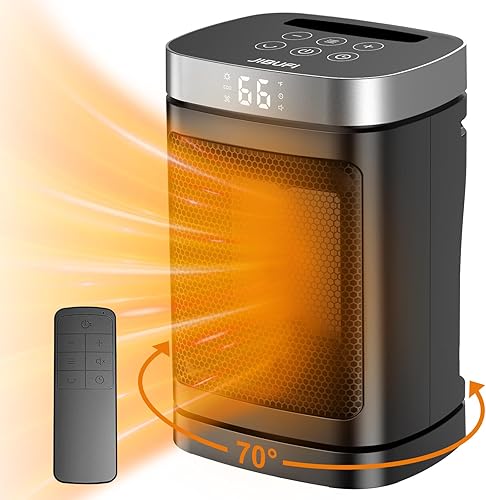
JIBUFI Portable Space Heater for Indoor Use
Best for moving between rooms
The best electric space heaters for a sunroom
Every heater here runs on 1500W and has tip-over and overheat protection. What separates them is how they spread heat, how much floor or table space they take, and how much control you get over the temperature.
Amazon Basics Ceramic Space Heater: Best overall
- Three settings: High 1500W, Low 900W, Fan Only
- Tip-over and overheat protection
- 43 dB noise level
- Weighs 2.8 lb
A compact ceramic heater with a real thermostat and a fan-only mode, so it warms a seating corner quickly and moves air on milder days.
Pros
- Three heat and fan settings
- Tip-over and overheat protection
- Light enough to carry between rooms
Cons
- Not for humid or damp areas
- Heats a corner, not a whole glass room
The Amazon Basics heater suits the person who reads or drinks coffee in one spot of the sunroom. Its ceramic element heats up in minutes, and the 43 dB noise level keeps it from drowning out conversation or a podcast.
Three settings give you real choice: High at 1500W for cold mornings, Low at 900W for milder afternoons, and Fan Only to move air without adding heat. The adjustable thermostat goes up to 130 F, so you can dial in a comfortable corner.
At 2.8 lb and about 9.5 in tall, it moves easily from a side table to the floor. It draws 12.5 A and runs on a corded connection.
One caution from Amazon Basics: keep it out of bathrooms, laundry rooms and other high-moisture areas. A sunroom that stays dry is fine, but a damp, leaky glass room is not its home.
Buy it for a small seating area in a dry sunroom. Skip it if you need to warm the whole room or the space stays humid.
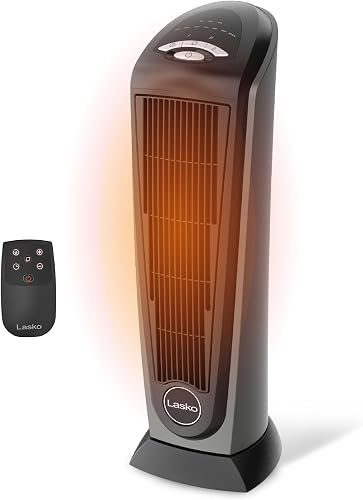
Lasko 751320 Ceramic Tower: Best for wide rooms
- 1500W ceramic heat with oscillation
- Remote control and 7-hour timer
- ETL certified
- Cool-touch housing
A tower with oscillation that sweeps warm air across a long sunroom, plus a remote so you don't get up from the couch to change settings.
Pros
- Oscillation spreads heat sideways
- Remote and 7-hour timer
- Two quiet heat settings
Cons
- Takes up more floor space than a tabletop unit
- Top temperature of 85 F limits very warm settings
The Lasko tower is the pick for a wide sunroom where people sit on opposite sides. Its oscillation sweeps warm air side to side, so the sofa and the reading chair both get heat rather than one hot stream.
It's rated for coverage up to 150 sq ft.
The remote controls heat settings, oscillation and a 7-hour timer, so you can change things without leaving your seat. Its thermostat range runs from 60 to 85 F, which covers typical comfort settings but caps how warm it will push the room.
Two quiet comfort settings keep it from sounding like a small fan on high.
Lasko builds in a self-regulating ceramic element, overheat protection and a cool-touch housing, and the heater is ETL listed. That matters in a room where kids or pets move around near the unit.
The 22.5 in tower needs more floor space than a tabletop model, though at 2.5 lb it still moves without strain.
Buy it for a long, wide room where even heat matters, and skip it if your sunroom is small enough that one corner unit will do.
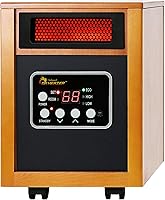
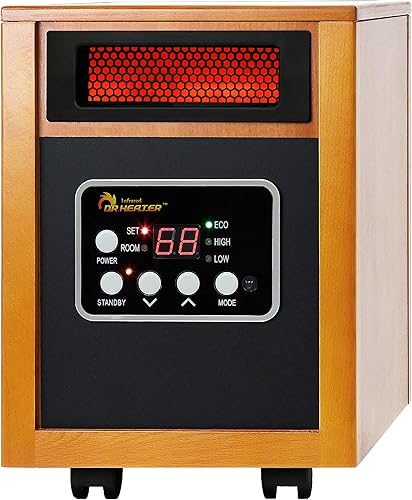
Dr Infrared DR-968 Heater: Best for large glass rooms
- Dual infrared quartz and PTC heating
- Rated around 5200 BTU
- 12-hour auto shut-off
- Caster wheels and lifetime filter
The biggest coverage in this group, with radiant heat that warms surfaces and people rather than just the air in a glassy room.
Pros
- Coverage up to 576 sq ft
- Runs at 39 dB
- Casters make it easy to move
Cons
- Heaviest pick at 19 lb
- Cabinet design needs more floor room
The DR-968 is the strongest choice for a big glass room. Dr.
Infrared rates it for up to 576 sq ft, the largest coverage in this group, and its dual system pairs an infrared quartz tube with a PTC element to push out heat rated around 5200 BTU.
Infrared heat warms surfaces and people directly rather than just the air. In a sunroom where warmth leaks through glass, that direct heat often feels better sooner, though it works best with clear line of sight to the unit.
It's also the quietest big option at 39 dB, and a 12-hour auto shut-off means it won't run all night if you forget. The electronic thermostat runs from 50 to 85 F.
Caster wheels and a lifetime filter make it easier to live with over time, and the 72-inch cord gives you more room to place it.
The trade-off is size and weight. At 19 lb and 16 in tall in a cabinet body, it takes a real corner and isn't something you'll move every day.
Buy it for a large sunroom you heat on a schedule, and skip it for a small room where a compact unit is easier.
WINHL Space Heater: Best for desk corners
- 1500W PTC ceramic heat
- 70-degree oscillation
- Remote, thermostat and 12-hour timer
- Overheat and tip-over shutoff
A small tower that fits on a side table and sweeps heat across a reading nook without taking floor space.
Pros
- Compact footprint for a tabletop
- Wide 70-degree oscillation
- Thermostat up to 95 F
Cons
- Built for personal space, not whole-room heat
- Remote needs two AAA batteries
The WINHL heater suits a sunroom used as a home office or reading nook. Its 70-degree oscillation sweeps warm air across a desk or chair instead of blasting one spot, and the remote lets you change temperature and modes without getting up.
Five modes give you more choices than a simple on-off dial.
It's small, at about 9.9 in tall and 5.9 in deep, so it fits on a side table or nightstand without eating floor space. A thermostat up to 95 F and a 12-hour timer give you more control than a simple dial, and ECO mode cycles the heater on and off to hold your setting.
WINHL is clear that this is supplemental heat for personal spaces, not a whole-room unit. Plug it straight into a 15A wall outlet and never into an extension cord or power strip.
It's ETL listed for safety. The remote needs two AAA batteries, which aren't included.
Buy it for a desk or chair corner where you sit for hours, and skip it if your sunroom is big enough to need real room-wide coverage.
VOCRS Small Portable Space Heater for Indoor: Best for tight budgets
- Three modes: 700W, 1000W, 1500W
- Remote control and 12-hour timer
- Overheat and tip-over shutoff
- ETL certified
A small heater with three power levels and a low 700W setting that's easier on a sunroom circuit shared with lights.
Pros
- Low 700W mode for mild days
- Remote and 12-hour timer
- Carry handle for moving it around
Cons
- Small cabinet limits throw distance
- No oscillation mentioned
The VOCRS heater is the value pick for a sunroom that's only chilly part of the time. Its three modes (700W, 1000W and 1500W) let you run it low on a sunny afternoon and turn it up after the sun drops.
Coverage is rated at 200 sq ft.
A 700W setting is gentler on the circuit, which helps in a sunroom where lights and a ceiling fan already draw power. The remote, digital display and 1-12 hour timer make it easy to set and forget, and the display shows the temperature and operating status at a glance.
It's ETL certified with overheat and tip-over shutoff, and a carry handle makes it easy to move between rooms. The built-in handle also helps when you want to carry it in from a cold car or out to a covered porch on a mild evening.
The small cabinet means heat doesn't throw as far as a tower, and there's no oscillation to spread it. Buy it for a modest sunroom on a budget, and skip it if you need wide coverage or a unit that sweeps the room.
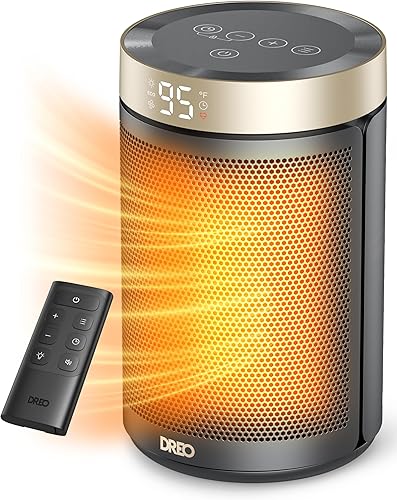
DREO Atom One Thermostat Heater: Best temperature control
- Thermostat from 41 to 95 F in 1 F steps
- 34 dB quiet operation
- Remote, 12-hour timer and child lock
- ETL certified with tip-over protection
The most precise thermostat here, set in 1 F steps, so a sunroom that swings with the afternoon sun holds a steady temperature.
Pros
- Thermostat in 1 F increments
- Quiet at 34 dB
- Child lock and memory function
Cons
- Personal-space coverage, not a big room
- Remote batteries not included
The DREO Atom One is the pick when temperature control matters most. Its thermostat runs from 41 to 95 F in 1 F steps, so you can hold a precise setting as the sunroom warms and cools through the day.
That precision helps in a glass room, where the temperature can swing several degrees between lunch and dusk. A memory function keeps your setting after a power blip, and a child lock stops small hands from changing it.
Mute and ECO modes round out the controls, so you can run it quietly and efficiently.
DREO rates noise at 34 dB, among the quietest here, so it won't interrupt a nap or a call. The heater is ETL certified with tip-over protection and V0 flame-retardant materials.
It weighs 3 lb and stands 10 in tall, which keeps it easy to shift between the floor and a low table.
It's a personal-space heater, so expect it to warm a seating area rather than a whole room. Buy it for steady, precise warmth where you sit, and skip it if raw coverage is your main need.
DREO 16 Inch Tower Heater: Best for long sunrooms
- 1500W PTC heat covering up to 250 sq ft
- 70-degree wide-angle heating
- 24-hour auto-off and Shield360 safety
- 34 dB quiet operation
A 16-inch tower that spreads heat across a long, narrow sunroom and stays quiet enough for an afternoon nap.
Pros
- 70-degree wide-angle heat
- Quiet 34 dB motor
- 24-hour auto-off for forgetful evenings
Cons
- 16 A amperage needs a dedicated circuit
- Floor placement only
The 16-inch DREO tower suits a long, narrow sunroom where heat needs to travel sideways. Its 70-degree wide-angle heating spreads warmth across the room, and DREO rates coverage up to 250 sq ft.
The heat travels at 11.8 ft/s, so it reaches the far end of a narrow room faster than a small corner unit.
It runs at 34 dB, quiet enough for an afternoon nap, with a 24-hour auto-off so it won't run unattended overnight. The Shield360 system adds tip-over and overheat protection, V-0 flame-retardant materials and a safety plug.
The digital thermostat runs from 41 to 95 F in 1 F steps, matching the Atom One's precision in a taller body that reaches more of the room. Note the 16 A amperage: it wants a dedicated circuit, so check what else shares that sunroom outlet.
At 5.1 lb it's light enough to move, but the floor is its only home.
Buy it for a long room where a tower's height and spread help, and skip it if your wiring can't give it a clear circuit.
AUBKN X-Large 1500W Electric Space Heaters: Best for tall windows
- 1500W PTC ceramic heat in 3 seconds
- 70-degree oscillation
- 12-hour timer and 24-hour auto-off
- 6 ft power cord
A 24-inch tower whose height puts warm air near window level, where glass loses heat fastest in a sunroom.
Pros
- Tall body reaches window height
- 12-hour timer and 24-hour auto-off
- 6 ft cord gives placement room
Cons
- 12.5 A draw needs a solid wall outlet
- Remote needs AAA batteries
The AUBKN heater is the pick for a sunroom with tall windows. At about 23 in high, its body puts warm air closer to window level, where glass loses heat fastest.
It heats in about 3 seconds with PTC ceramic and spreads warmth with 70-degree oscillation. A 12-hour timer and a 24-hour auto-off without interaction add safety for evenings when you forget to switch it off.
Three speeds let you run it low when the afternoon sun is doing most of the work.
The 6 ft power cord gives you more placement room than shorter cords, which helps when the nearest outlet sits behind a plant or a chair. It's ETL certified with tip-over and overheat protection and flame-retardant materials, and coverage is rated at 200 sq ft.
The 12.5 A draw needs a solid wall outlet, and the remote needs AAA batteries. Buy it for a room with high glass and a reachable outlet, and skip it if you need a tabletop size.
JIBUFI Portable Space Heater for Indoor Use: Best for moving between rooms
- 1500W heat covering up to 200 sq ft
- 70-degree oscillation
- ECO mode and five operating modes
- ETL certified with tip-over protection
A desktop-size heater light enough to carry from the sunroom to the kitchen, with an ECO mode that self-sets the temperature.
Pros
- Five modes including ECO
- Compact and easy to carry
- Wide oscillation
Cons
- Floor or desk placement only, no tower height
- Remote batteries not included
The JIBUFI heater suits someone who uses the sunroom in the morning and the kitchen at night. It's compact and light enough to carry, with a 70-degree oscillation and five modes including ECO.
At 5.5 in deep and 10 in tall, it slips onto a shelf or a corner of the floor.
ECO mode self-sets the temperature to hold your target and save energy, which fits a sunroom that only needs help on cool days. The heater is ETL certified with tip-over protection, an enhanced safety plug and flame-retardant materials.
A 12-hour timer and a remote make it easy to run from across the room.
JIBUFI rates coverage at 200 sq ft. It sits on the floor or a desk rather than as a tower, so it works best close to where you sit.
The remote needs two batteries, which aren't included.
Buy it for a small sunroom you also heat elsewhere, and skip it if you want one unit to stay put and cover a big glass room.
How these sunroom heaters compare
The comparison table lines up the specs that matter most in a glass room: heat output, size, coverage and thermostat range. Read it by your room's size and shape first, then by the controls you want.
| Product | Best for | Heat output | Size (D x W x H) | Thermostat | Our score |
|---|---|---|---|---|---|
| Amazon Basics Ceramic Space Heater | overall | 1500 W | 7.52 x 6.34 x 9.45 in | Adjustable, up to 130 F | 9.6 |
| Lasko 751320 Ceramic Tower | wide rooms | 1500 W | 8.3 x 7.25 x 22.5 in | 60 to 85 F | 9.1 |
| Dr Infrared DR-968 Heater | large glass rooms | 1500 W | 13 x 11 x 16 in | 8.9 | |
| WINHL Space Heater | desk corners | 1500 W | 5.91 x 5.91 x 9.85 in | Up to 95 F | 8.8 |
| VOCRS Small Portable Space Heater for Indoor | tight budgets | 1500 W | 5.8 x 5.5 x 8.5 in | 8.7 | |
| DREO Atom One Thermostat Heater | temperature control | 1500 W | 6.02 x 6.02 x 10 in | 8.6 | |
| DREO 16 Inch Tower Heater | long sunrooms | 1500 W | 6.38 x 6.1 x 15.83 in | 8.6 | |
| AUBKN X-Large 1500W Electric Space Heaters | tall windows | 1500 W | 5.51 x 5.51 x 23.09 in | 8.3 | |
| JIBUFI Portable Space Heater for Indoor Use | moving between rooms | 1500 W | 5.5 x 6.75 x 10 in | 8.2 |
How we compared these heaters
We compared these heaters on the specs that decide how a sunroom feels: heat type, rated coverage, footprint, thermostat range, noise level and safety features. We weighed each against what a sunroom user needs, then scored them on how well they fit that job.
Heat type came first. Ceramic and PTC heaters warm the air and feel quicker in a closed corner; infrared heats surfaces and people and suits a glassy room where air warmth escapes.
Coverage ratings from each brand told us which units are built for a corner and which for a whole room. We also noted how each unit's size and weight affect where it can sit, since a glass room often leaves little wall or floor space.
Safety features were a hard requirement. Every pick here has tip-over and overheat protection, and most are ETL certified.
We also noted amperage, because a 1500W heater draws 12.5 A or more and a sunroom circuit is often shared. A model that needs 16 A, like the 16-inch DREO, asks more of your wiring than one rated at 12.5 A.
Our score weighs specs, features and buyer feedback against what you're shopping for. The Amazon Basics unit leads because it combines quick ceramic heat, a real thermostat and strong safety in a small body at a low weight.
The DR-968 ranks high for raw coverage but loses points for its size and weight, which make it a fixed piece of furniture rather than something you shift with the sun.
What should you check before buying a sunroom heater?
Check the room's size and how much glass it has, then match the heater's coverage and placement to where you actually sit. A sunroom's heat loss is the deciding factor, not its square footage alone.
A compact unit near your chair often beats a bigger one stuck in a corner far from where you spend time.
How big is the space you need to warm?
A 1500W heater handles a seating area of about 200 sq ft, which covers most sunrooms used as a reading or coffee room. A larger glass room needs a unit rated higher, like the DR-968 at 576 sq ft, or more than one heater.
Be honest about what "warming the room" means for you. If you sit in one chair for an hour, a 200 sq ft rating is plenty.
If you host people spread around a long table, look at the wide-angle towers or the DR-968.
Where will the heater sit?
Tabletop units like the Amazon Basics and WINHL fit on a side table and warm one person. Tower and cabinet models reach more of the room but take floor space.
Leave a few feet clear of curtains, blinds and furniture. The AUBKN's 23 in height suits tall windows, while the 16-inch DREO fits beside a narrow seating run.
How much control do you want?
A simple dial is fine for occasional use. If the sunroom swings with the sun, a thermostat set in 1 F steps, like the DREO models, holds a steadier temperature.
Remotes and timers help when the unit sits across the room. Check what the remote actually controls: on the Lasko it handles heat settings, oscillation and the timer, while some cheaper units only cover the basics.
Which heat type suits a glass room?
Ceramic and PTC heaters warm the air, so they feel quick in a small, closed corner. Infrared heaters warm surfaces and people directly, which helps when glass is leaking air warmth.
If your sunroom is mostly glass and you sit close to the unit, infrared can feel warmer sooner. If the room is small and well sealed, a ceramic unit like the Amazon Basics is simpler and cheaper to run.
How do you heat a sunroom safely?
Heat a sunroom safely by plugging the heater straight into a wall outlet, keeping it clear of curtains and glass, and using its tip-over and overheat protection as designed. Never run it on an extension cord or power strip.
Can a sunroom circuit handle a 1500W heater?
A 1500W heater draws about 12.5 A, and some models draw 16 A. Most household circuits are 15 A, so a heater on the same circuit as lights or a fan can trip the breaker.
Give it an outlet of its own where you can.
Check the label on the breaker before you commit. If the sunroom shares a circuit with the kitchen or a garage outlet, a 16 A unit like the 16-inch DREO may trip it the first cold morning.
A model with a low setting, like the VOCRS at 700W or the Amazon Basics at 900W, gives you a way to run it without maxing the circuit.
What should stay away from the heater?
Keep curtains, blinds, rugs and furniture at least a few feet from the unit. In a sunroom, glass and fabric are close together, so set the heater on a flat, clear spot and don't drape anything over it.
Don't push it against the coldest window pane, either, since that spot chills the unit and wastes its heat.
Can you leave a sunroom heater running unattended?
Don't leave a portable heater running while you're out of the room. If you want it on a schedule, choose a model with an auto-off timer, like the DR-968's 12-hour shut-off or the AUBKN's 24-hour auto-off.
Timers also help when you heat the room before you use it: set it to come on an hour before you sit down, and let it shut off on its own.
How do you keep a sunroom heater working well?
Keep a sunroom heater working well by cleaning its filter or intake regularly, checking the cord and plug, and storing it dry when the season ends. Dust and damp are the two things that shorten a heater's life.
How often should you clean it?
Clean the intake and any filter every few weeks during heating season, more often in a dusty sunroom. A clogged intake makes the heater work harder and can trigger its overheat shutoff.
Our guide on how to clean a space heater walks through the steps safely. Models with a lifetime filter, like the DR-968, still need that filter rinsed and dried.
How long should a sunroom heater last?
Most portable heaters last several seasons with regular cleaning and careful storage. How long yours lasts depends on run time, dust and moisture.
Our article on how long space heaters last covers the signs it's time to replace one. A sunroom that stays dry and dust-free gives a heater an easier life than a damp, gritty space.
Can you use a sunroom heater in a damp room?
Only if the room stays dry. Amazon Basics specifically warns against bathrooms and laundry rooms, and damp air is hard on any electric heater.
If your sunroom leaks or holds moisture, fix that before adding heat. A damp room also makes the heater cycle more often as it fights the chill, which wears it out faster.
Which sunroom heater should you buy?
Buy the Amazon Basics Ceramic Space Heater if you want the best electric space heater for a sunroom corner at a low weight. Choose the DR-968 for a large glass room, the Lasko or DREO 16 Inch Tower for a wide or long space, and the WINHL or DREO Atom One for precise warmth where you sit.
For a room that's only chilly now and then, the VOCRS or JIBUFI heater gives you low settings and portability without much floor space. If your sunroom shares a wall with a basement you also want to heat, our roundup of the best space heater for a basement covers that job.
And if you're heating a bigger open space, see our picks for an electric space heater for a large garage.
Whatever you pick, place it near where you sit, keep the glass and curtains clear, and give it its own outlet. That's what makes a sunroom heater useful rather than just another appliance in the corner.
Our top 3 picks at a glance
-
1
-
2
-
3
Frequently asked questions
Can a space heater keep a sunroom warm in winter?
It can warm the space while you're in it, but not replace a room's main heat source. A 1500W heater suits a corner or seating area in a three-season sunroom; an unheated glass room in freezing weather will lose heat faster than one small heater can replace it.
How many watts do I need for a sunroom?
Most sunrooms work well with a 1500W heater for a seating area of up to about 200 sq ft. A larger glass room needs more than one unit or a higher-output model, since glass loses heat faster than an insulated wall.
Where should I put a space heater in a sunroom?
Place it near where you sit, not against the coldest glass, so the heat reaches people first. Keep it a few feet from curtains, blinds and furniture, and set it on a flat surface so the tip-over switch works as designed.
Is it safe to run a space heater in a sunroom?
Yes, if the heater carries tip-over and overheat protection and you plug it straight into a wall outlet. Sunrooms often run lights and fans on the same circuit, so don't share that outlet with other high-wattage appliances or use an extension cord.
Do ceramic or infrared heaters work better in a sunroom?
Ceramic heaters warm the air and are quicker to feel in a small, closed space. Infrared heats surfaces and people directly, which helps in a glassy room where air warmth leaks out, but it's more directional and needs clear line of sight.